Showing posts with label prisons. Show all posts

2009-01-23

Creating Prisoners is a Booming Industry in Need of a Bust

In 2008, the United States passed a benchmark previously unheard of. For the first time in the nation’s history, every one in 100 adults was behind bars, making it no question that the USA is number one in the world when it comes to making people prisoners.

Since 1980, the overall prison population has seen a 400 percent surge.

For almost 30 years the people of this nation have watched blindly as state and federal legislatures composed hyperbolic crime-fighting schemes with euphemistic titles like: “tough on crime,” “truth in sentencing,” “three strikes,” or “The War on Drugs.”

We ate up the façade of security while they scaled back the evolution of the American justice system.

There exists, in this country, a prison industrial-complex.

An organized and systematic network of interest groups, lawyers, politicians, prison guard unions and construction companies, who form the cyclic mechanisms which hold the socially destructive machine in place.

They are the profiteers of imprisonment, bound not by the desire to correct or rehabilitate, but by the scent of big business.

See also:

Excellent Article on the Corrupt Prison-Industrial Complex

The Militarization of our Local Police

How you became the enemy

Prisoners In 2007: 1 in 31 American Adults Now in Prison, Jail or on Parole

Democracy’s Ghosts: How 5.3 Million Americans Have Lost The Right To Vote

November Coalition

We sat around and watched as they built them up, one by one. Big concrete blocks built to hold as many human bodies as they could.

In some cases private companies built their for-profit prisons before they had even received a contract from the government.

In one such case in 1997, a company called Corrections Corporation of America (a major contributor to the American Legislative Exchange Council) built a 2,000-bed facility in California at a cost of $80-$100 million with no contract from the California Department of Corrections.

“If we build it, they will come,” said one of the company officials.

They did come, and that is the problem.

The prison industry has seen a massive boom in last few decades, and when the industry that symbolizes crime-fighting sees a boom, we are led to believe that it is crime that suffers.

Politicians gawk at the chance to rubber stamp their name on anything that will equate to positive crime-fighting statistics.

Yet, is it logical to believe that the true path to achieving a society less rampant with crime is to lock up one of every 100 citizens?

The state of California has been a prison playground for this past boom in corrections.

However, with the economy $41 billion in the hole, and prison overcrowding increasing faster than they can build prisons, it is incredibly imperative that action be made to twinge the machine rightward.

Gov. Arnold Schwarzenegger wants to eliminate parole for all offenders not convicted of violent or sex-related crimes, reducing the parole population by about 70,000.

He also wants to divert more petty criminals to county jails and grant early release to more inmates - steps that could trim the prison population by 15,000 over the next 18 months.

These actions may very well represent the light at the end of a tunnel, an indirect chance for Legislature to stop concurring with those out to make money in the “prison business” and a chance to bring the cogs of the complex to a complete stop.

If Schwarzenegger makes these changes then there is hope.

Our fiscal troubles as a state put us in a position to stand up to those lobbying for the imprisonment of more and more Americans in order to tell them that the expense will no longer be paid.

One of 100 is a number that will not be accepted, no one has that many criminals.

2009-01-22

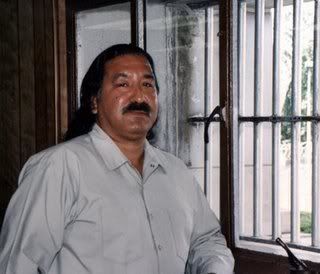
Leonard Peltier beaten in prison

By Brenda Norrell

Photo LPDOC

CANAAN, Penn. -- Leonard Peltier was jumped and beaten after being transferred from a prison in Lewisburg to Canaan on January 13. The family, however, was not notified by the prison and received the information by way of a letter from Peltier. Peltier, 64, was placed in solitary confinement and it is not known if he has received medical attention.

"Once Mr. Peltier arrived at the Canaan prison facility, he was jumped by younger inmates, severely beaten, put in solitary confinement and placed upon meal restrictions despite his having diabetes and other medical conditions," the Leonard Peltier Defense Offense Committee said in a statement ."The family has requested copies of the video tapes of that incident to no avail. It is as if the whole scenario was contrived to detract from the fact that Mr. Peltier has been a model prisoner having more than enough points to qualify for parole," LPDOC said.

Recently, the amount of hate mail circulated on the Internet regarding Peltier and appeals for his release has increased and could have played a role in the attack on Peltier.

The LPDOC said, "Retired, former and actively employed FBI agents have taken action against the release and parole of Leonard Peltier time and again. While it is their right to speak their opinion, it is not right to do so on federal time and at the taxpayer’s expense. Their letters, writings, articles, books, protests, outcries and interviews concerning Mr. Peltier, are a conflict of interest and tip the scales against him unfairly. In addition, it is certainly questionable as to the timing of a letter written by a former FBI Agent to Representative John Conyers and the beating Mr. Peltier received at Canaan."

The LPDOC said the attack on Peltier comes on the heels of the FBI's recent letter, prompting this attack by FBI supporters as an attempt to discredit Peltier as a model prisoner. "Anyone who has been in the prison system knows well that if you refuse to name your attackers or file charges against them, then you lose your status as a victim and/or given points against your possible parole and labeled as a perpetrator. It is not uncommon, in fact is quite common for the government to use Indian against Indian and they still operate under the old adage "it takes an Indian to catch an Indian," LPDOC said.

In 1978, the US government made an attempt to assassinate Peltier, offering another Indian inmate at Marion prison with Leonard Peltier, a chance at freedom. The man was Standing Deer. Standing Deer befriended Peltier in prison and exposed the plot to assassinate him. Standing Deer was murdered in Houston after his release from prison.

LPDOC said, "Standing Deer chose to reveal the plot to him instead of taking his life in exchange for a chance at freedom. When Standing Deer was released in 2001, he joined the former Leonard Peltier Defense Committee as a board member. He also began to speak on Leonard's behalf until his murder six years ago today. Prior to his murder, Standing Deer confided with close friends and associates that the same man who visited him in Marion to assassinate Peltier, had came to Houston and told him that he had better stay away from Peltier and anything to do with him," the LDPOC said. (An interview with Ben Carnes on Standing Deer and Peltier can be heard at Censored News Blog Radio or at Earthcycles on Longest Walk.)

Micheal Kuzma, an attorney for Leonard Peltier's defense, described the attack on Peltier in prison, during an interview with American Indian Airwaves on Wednesday, Jan. 21. Kuzma said Peltier's sister Betty Peltier-Solano, executive coordinator of the Leonard Peltier Defense Offense Committee,
received a letter from Peltier, but was never notified by prison officials of the attack. Peltier was transferred from Lewisburg to Canaan prison during the week of Jan. 12th and attacked on the 13th, by other inmates.

Kuzma said, "According to the letter, he thinks he might have a concussion. His middle finger on his left hand is either broken or badly injured. He has a large bump near his right wrist. The right side of his rib cage and chest are in pain. He also has a bruise on the right side of his chest. He also has a bruise on his left knee, and is suffering from headaches. These headaches are a direct result of the Jan. 13 beating."
Listen (last 20 minutes of program) on Jan. 21 at:
http://archive.kpfk.org/parchive/xml/americanindian.xml

AIM West plans a protest in solidarity with Peltier to draw attention to the attack and call for his release on Friday in San Francisco. http://www.aimwest.info/

For more information: LPDOC: http://www.whoisleonardpeltier.info/

Updates at Censored News: http://www.bsnorrell.blogspot.com

2008-12-10

AFP Talks with Texas DA Who Brought Indictments Against Dick Cheney & Alberto Gonzales

The Radicalization Of An American Prisoner

By George Peter Jr.

December 05, 2008 "Information Clearinghouse" --- During a hearing before the Senate Intelligence Committee in 2006, high- ranking F.B.I. officials testified that the Bureau considered U.S. prisons to be "fertile grounds for extremists", and that they were in the process of developing "threat assessments" for those individuals who may have become "radicalized" during their incarceration.

Listening to those officials postulate a variety of theories as to the perceived radicalization of American prisoners since 9/11, ranging from a misguided identification with terrorist leaders such as Osama bin Laden, to the radical preachings of jailhouse religious leaders, it became readily apparent that today's F.B.I. is as out of touch with reality as the one headed by J. Edgar Hoover, which for decades denied the existence of the mafia.

As one who has been confined in the Illinois Department of Corrections since 1967, I myself have observed a change in the attitudes and political philosophy of the average American prisoner, shaped not because of an external event occurring in some distant land, or the importation of some radical religion; but instead, due to the unrelenting assault upon prisoners by state houses around the nation, the unwillingness and/or inability of states to protect those who are imprisoned in their penal systems, the dual-standard of justice imposed upon prison guards who commit criminal acts against prisoners, and the daily vilification and demonization of those caught up in the criminal justice system, best exemplified in such television shows as "Cops", "Nancy Grace", and MSNBC's "Lockup" the ultimate in reality programming.

To help one get a clearer understanding of this issue, let us utilize the eyes of a hypothetical prisoner we'll call him "Tony" returning to the Menard Correctional Center, after living in the outside world for the last decade; what would he observe? Probably the first thing he would sense is a feeling of abandonment, due to the near complete abolishment of any meaningful rehabilitative programming. Thanks to the efforts of William Jefferson Clinton, the college classrooms have been long shuttered, as have the vocational schools, due to the elimination of prisoner access to the federal government's Pell Grants.

Tony would further note that the prison has abolished every organizational recreational activity previously used to release tension and help maintain control of the facility. Now he would find himself confined in a space 4' 3" by 10', with another prisoner, for a minimum of 159 hours a week, with little but a television set to help while away the hours. His cell is so small that it contains no table or chair, and the space between the bunks is so small 26" that he must sit on the toilet if he wishes to write a letter. Other than that, his only options are to lie down, or stand up.

Although lockdowns occurred during Tony's previous incarceration, they were primarily used in response to large-scale confrontations between various factions of the prison community, and to conduct periodic searches for contraband. He will now see that they are routinely scheduled to facilitate employee absences over the Thanksgiving and Christmas holidays, as well as the annual deer-hunting season.

When he walks into the dining room, he will discover he is now allotted only ten minutes to eat a barely palatable meal, but due to the miniscule portions, that will be more than a sufficient amount of time. Surprisingly, he will learn that the prison guard's union has publicly described the food served as "barely edible1."

If he believes that the conditions he is confined under are unconstitutional, this is probably at least partially attributable to the fact that the federal enforcement of civil rights laws has dropped precipitously since 1999. According to the Transactional Records Access Clearinghouse at Syracuse University, the Justice Department has seen the prosecution of civil rights cases fall by one-third through 2005. Additionally, the state statute that allowed clergy and attorneys to monitor the constitutional rights of prisoners was repealed.

Borrowing some reading material from a neighbor, Tony reads multiple examples of the duplicitous nature of the criminal justice system, how it inflicted Draconian penalties upon those who committed trivial offences during incarceration, while those employed by the government would receive, at worst, a mere slap on the wrist, when discovered abusing those under their control. The penalty imposed upon Colorado prisoner Douglas Wilson for passing out an extra cheese sandwich to fellow convicts was three additional years in prison; while in May 23, 2006 Illinois prison guard Clarence Howard was sentenced to two years probation for smuggling drugs into the facility where he worked.2 When Pennsylvania prisoner Darren Miller threw urine on a guard, he had 15 more years tacked onto his sentence, whereas Hawaiian prison guard Brian Freitas was placed on one year's probation for his rôle in the murder of prisoner Antonio Revera.3

However, what Tony found the most appalling were the direct assaults upon the minimal rights of those confined all around the country. When inmates had the audacity to actually seek the protection of laws enacted by state legislatures, they discovered the courts unwilling to ensure the safeguarding of these basic rights. When the mother of a Connecticut prisoner sued the state for the failure to treat her son in accordance with the state's "Patient's Bill of Rights", the prison system did not deny the allegations; rather they claimed in court that the Bill of Rights did not apply to prisoners. The state's supreme court agreed.

After receiving numerous complaints of employee misconduct against youths confined in Oklahoma's maximum security prison for youthful offenders, the state's attorney general's office declined to investigate, citing budgetary woes. This is the same state that chose to expend millions of dollars to secure additional life sentences against Timothy McVie's co-defendant, Terry Nichols, after he had already received a life sentence in federal court.

Closer to home, Tony gained a degree of understanding as to why Illinois' prisons appeared to be in a state of mismanagement. This came to light as he read about the investigation of the March 2, 2006 murder of an inmate at the Muddy River Correctional Center, where it was discovered that assistant warden Julie Wilkerson's only apparent qualifications for her job were the campaign contributions she made to Governor Rod Blagojevich. Ms. Wilkerson is a former music teacher, with no prior prison experience.

Tiring of this self-flagellation, Tony turns on the television, where he discovers that law and order shows appear to be the flavor of the day. As he looks in on "The Nancy Grace Show", he quickly discerns that Miss Grace routinely projects an attitude of unbridled anger and animosity towards anyone who disagrees with her prosecutorial mindset. Most frightening in her telecasts are the incessant and one-sided diatribes spewed forth against whichever criminal defendant she is focusing on in that particular episode. While her viewers may not be cognizant of her ability to appreciate the finer points of due process, the Georgia Supreme Court has, as it rebuked her on multiple occasions for her "unethical behavior" in securing criminal convictions. In comparison to this bubble-headed bleach blonde, Ann Coulter is a flaming liberal.

Flipping the dial, in search of something less intense, Tony tunes into "Cops", a program devoted almost entirely to showing slow-footed African and Appalachian Americans attempting to out-run the police unsuccessfully, I might add and then being body slammed to the ground when they get caught. While not a serious show, it still serves to humiliate and dehumanize those appearing on it.

Lastly, he tunes into MSNBC's "Lockdown", undoubtedly the most insightful of the crime programs he has seen, as the camera takes the viewer into prisons across the nation mostly maximum and super-maximum security for an up-close and personal view. Unfortunately, what it so clearly displays is the rampant brutality and stifling isolation these human beings are exposed to, year after year. Little mention is made to explain how these prisoners could possibly be expected to successfully re-enter society after surviving this man-made hellhole.

As this story comes full circle, Tony wishes that for just one day, those high-ranking F.B.I. officials could experience what prisoners around the nation have to live with on a daily basis. Only then could they begin to conceptualize the mis-treatment being inflicted upon those incarcerated in America's prisons, and the anger it breeds. Perhaps at this juncture they would realize that while there is a definite undercurrent of alienation and animosity within the country's prison population, it is not a radicalization born from the exposure to the vitriolic venom spewing from the mouths of psychotic mass murderers such as Osama bin Laden, an individual I would happily speed on the way to his reward of 72 virgins.

No, my "radicalization" as you describe it, has been incubated and nurtured by this cesspool you call a penal system, and every day your brutality adds yet another name on the rolls. At what point will you sit up and take note?

1. "Maximum Insecurity", at www.afscme31.org
2. Prison Legal News, June 2006, p. 42
3. Prison Legal News, June 2006, p. 35

Former Grant County, Kentucky Detention Center Officers Sentenced for Civil Rights Violations in Teenager Rape Case

WASHINGTON – Wesley Lanham, 31, and Shawn Freeman, 36, both former deputy jailers at Grant County Detention Center in Kentucky, were sentenced today on federal civil rights, conspiracy and obstruction charges. Lanham was sentenced to 15 years in prison and 3 years of supervised release, and Freeman was sentenced to 14 years in prison and 3 years of supervised release. Both defendants were found guilty of conspiring to violate the civil rights of a teenaged traffic offender by arranging for him to be raped by inmates. The jury convicted the defendants on all charges and specifically found that the defendants were responsible for the aggravated sexual assault carried out by the inmates.

"Although nothing can fully heal the wounds inflicted on this teenager, hopefully the defendants’ sentences today will bring closure to this young man and his family," said Grace Chung Becker, Acting Assistant Attorney General for the Civil Rights Division. "His courage in coming forward helps to ensure that egregious acts such as this one will be appropriately punished, and facilitates the Justice Department’s efforts to ensure the integrity of law enforcement."

The case stemmed from an incident that occurred on Feb. 14, 2003, when the defendants, along with their supervisor, former Sergeant Shawn Sydnor, taunted an 18-year-old high school student who had been brought to the detention center on a speeding charge. The deputies teased the teenager about his physical appearance and told him that he would make a good "girlfriend" for the other inmates. The defendants then solicited a group of convicted felons housed in a general population cell to scare and "mess with" the teenager. After eliciting an agreement from the inmates, the officers left the teenager in the cell where he was sexually assaulted by the other inmates.

When the teenager’s father reported the incident and demanded an investigation, the defendants falsified their official reports relating to the treatment of the teenager.

A third defendant, former Sergeant at the jail, Clint Shawn Sydnor, previously pleaded guilty to civil rights and conspiracy charges and was sentenced earlier today to 90 months in prison.

This case was prosecuted by Special Litigation Counsel Kristy L. Parker and Trial Attorney Forrest Christian of the Criminal Section of the Justice Department’s Civil Rights Division, with assistance from the U.S. Attorney’s Office for the Eastern District of Kentucky. The case was investigated by the Federal Bureau of Investigation.

Musicians protest use of songs on detainees

By Andrew O. Selsky - The Associated Press
Posted : Tuesday Dec 9, 2008 21:04:29 EST

GUANTANAMO BAY NAVAL BASE, Cuba — Blaring from a speaker behind a metal grate in his tiny cell in Iraq, the blistering rock from Nine Inch Nails hit Prisoner No. 200343 like a sonic bludgeon.

“Stains like the blood on your teeth,” Trent Reznor snarled over distorted guitars. “Bite. Chew.”

The auditory assault went on for days, then weeks, then months at the U.S. military detention center in Iraq. Twenty hours a day. AC/DC. Queen. Pantera. The prisoner, military contractor Donald Vance of Chicago, told The Associated Press he was soon suicidal.

The tactic has been common in the U.S. war on terror, with forces systematically using loud music on hundreds of detainees in Iraq, Afghanistan and Guantanamo Bay. Lt. Gen. Ricardo Sanchez, then the U.S. military commander in Iraq, authorized it on Sept. 14, 2003, “to create fear, disorient ... and prolong capture shock.”

Now the detainees aren’t the only ones complaining. Musicians are banding together to demand the U.S. military stop using their songs as weapons.

A campaign being launched Wednesday has brought together groups including Massive Attack and musicians such as Tom Morello, who played with Rage Against the Machine and Audioslave and is now on a solo tour. It will feature minutes of silence during concerts and festivals, said Chloe Davies of the British law group Reprieve, which represents dozens of Guantanamo Bay detainees and is organizing the campaign.

At least Vance, who says he was jailed for reporting illegal arms sales, was used to rock music. For many detainees who grew up in Afghanistan — where music was prohibited under Taliban rule — interrogations by U.S. forces marked their first exposure to the pounding rhythms, played at top volume.

The experience was overwhelming for many. Binyam Mohammed, now a prisoner at Guantanamo Bay, said men held with him at the CIA’s “Dark Prison” in Afghanistan wound up screaming and smashing their heads against walls, unable to endure more.

“There was loud music, (Eminem’s) ‘Slim Shady’ and Dr. Dre for 20 days. I heard this nonstop over and over,” he told his lawyer, Clive Stafford Smith. “The CIA worked on people, including me, day and night for the months before I left. Plenty lost their minds.”

Rear Adm. David Thomas, the commander of Guantanamo’s detention center, said the music treatment is not currently used at Guantanamo but added that he could not rule out its use in the future.

“I couldn’t speculate and I wouldn’t speculate but I can tell you it doesn’t happen here at Guantanamo and it hasn’t happened since I’ve been here,” Thomas, who has been at Guantanamo for a half-year, told AP.

The spokeswoman for Guantanamo’s detention center, Navy Cmdr. Pauline Storum, wouldn’t give details of when and how music has been used at the prison.

FBI agents stationed at Guantanamo Bay reported numerous instances in which music was blasted at detainees, saying they were “told such tactics were common there.”

According to an FBI memo, one interrogator at Guantanamo Bay bragged he needed only four days to “break” someone by alternating 16 hours of music and lights with four hours of silence and darkness.

Ruhal Ahmed, a Briton who was captured in Afghanistan, describes excruciating sessions at Guantanamo Bay. He said his hands were shackled to his feet, which were shackled to the floor, forcing him into a painful squat for periods of up to two days.

“You’re in agony,” Ahmed, who was released without charge in 2004, told Reprieve. He said the agony was compounded when music was introduced, because “before you could actually concentrate on something else, try to make yourself focus on some other things in your life that you did before and take that pain away.

“It makes you feel like you are going mad,” he said.

Not all of the music is hard rock. Christopher Cerf, who wrote music for “Sesame Street,” said he was horrified to learn songs from the children’s TV show were used in interrogations.

“I wouldn’t want my music to be a party to that,” he told AP.

Bob Singleton, whose song “I Love You” is beloved by legions of preschool Barney fans, wrote in a newspaper opinion column that any music can become unbearable if played loudly for long stretches.

“It’s absolutely ludicrous,” he wrote in the Los Angeles Times. “A song that was designed to make little children feel safe and loved was somehow going to threaten the mental state of adults and drive them to the emotional breaking point?”

Morello, of Rage Against the Machine, has been especially forceful in denouncing the practice. During a recent concert in San Francisco, he proposed taking revenge on President George W. Bush.

“I suggest that they level Guantanamo Bay, but they keep one small cell and they put Bush in there ... and they blast some Rage Against the Machine,” he said to whoops and cheers.

Some musicians, however, say they’re proud that their music is used in interrogations. Those include bassist Stevie Benton, whose group Drowning Pool has performed in Iraq and recorded one of the interrogators’ favorites, “Bodies.”

“People assume we should be offended that somebody in the military thinks our song is annoying enough that played over and over it can psychologically break someone down,” he told Spin magazine. “I take it as an honor to think that perhaps our song could be used to quell another 9/11 attack or something like that.”

The band’s record label told AP that Benton did not want to comment further. Instead, the band issued a statement reading: “Drowning Pool is committed to supporting the lives and rights of our troops stationed around the world.”

Vance, in a telephone interview from Chicago, said the tactic can make innocent men go mad. According to a lawsuit he has filed, his jailers said he was being held because his employer was suspected of selling weapons to terrorists and insurgents. The U.S. military confirms Vance was jailed but won’t elaborate because of the lawsuit.

He said he was locked in an overcooled 9-foot-by-9-foot cell that had a speaker with a metal grate over it. Two large speakers stood in the hallway outside. The music was almost constant, mostly hard rock, he said.

“There was a lot of Nine Inch Nails, including ‘March of the Pigs,”’ he said. “I couldn’t tell you how many times I heard Queen’s ‘We Will Rock You.”’

He wore only a jumpsuit and flip-flops and had no protection from the cold.

“I had no blanket or sheet. If I had, I would probably have tried suicide,” he said. “I got to a few points toward the end where I thought, ‘How can I do this?’ Actively plotting, ‘How can I get away with it so they don’t stop it?”’

Asked to describe the experience, Vance said: “It sort of removes you from you. You can no longer formulate your own thoughts when you’re in an environment like that.”

He was released after 97 days. Two years later, he says, “I keep my home very quiet.”

2008-12-09

Musicians don't want tunes used for torture


The Associated Press
5:48 PM EST December 9, 2008
The U.S. has used loud music against those held in Guantanamo Bay, Iraq and Afghanistan, and detainees now aren't the only ones complaining: Musicians are banding together to demand the U.S. military stop using their songs as weapons.
© AP

Blaring from a speaker behind a metal grate in his tiny cell in Iraq, the blistering rock from Nine Inch Nails hit Prisoner No. 200343 like a sonic bludgeon.

"Stains like the blood on your teeth," Trent Reznor snarled over distorted guitars. "Bite. Chew."

The auditory assault went on for days, then weeks, then months at the U.S. military detention center in Iraq. Twenty hours a day. AC/DC. Queen. Pantera. The prisoner, military contractor Donald Vance of Chicago, told The Associated Press he was soon suicidal.

The tactic has been common in the U.S. war on terror, with forces systematically using loud music on hundreds of detainees in Iraq, Afghanistan and Guantanamo Bay. Lt. Gen. Ricardo Sanchez, then the U.S. military commander in Iraq, authorized it on Sept. 14, 2003, "to create fear, disorient ... and prolong capture shock."

Now the detainees aren't the only ones complaining. Musicians are banding together to demand the U.S. military stop using their songs as weapons.

A campaign being launched Wednesday has brought together groups including Massive Attack and musicians such as Tom Morello, who played with Rage Against the Machine and Audioslave and is now on a solo tour. It will feature minutes of silence during concerts and festivals, said Chloe Davies of the British law group Reprieve, which represents dozens of Guantanamo Bay detainees and is organizing the campaign.

At least Vance, who says he was jailed for reporting illegal arms sales, was used to rock music. For many detainees who grew up in Afghanistan - where music was prohibited under Taliban rule - interrogations by U.S. forces marked their first exposure to the pounding rhythms, played at top volume.

'Plenty lost their minds'
The experience was overwhelming for many. Binyam Mohammed, now a prisoner at Guantanamo Bay, said men held with him at the CIA's "Dark Prison" in Afghanistan wound up screaming and smashing their heads against walls, unable to endure more.

"There was loud music, (Eminem's) 'Slim Shady' and Dr. Dre for 20 days. I heard this nonstop over and over," he told his lawyer, Clive Stafford Smith. "The CIA worked on people, including me, day and night for the months before I left. Plenty lost their minds."

The spokeswoman for Guantanamo's detention center, Navy Cmdr. Pauline Storum, wouldn't give details of when and how music has been used at the prison, but said it isn't used today. She didn't respond when asked whether music might be used in the future.

FBI agents stationed at Guantanamo Bay reported numerous instances in which music was blasted at detainees, saying they were "told such tactics were common there."

According to an FBI memo, one interrogator at Guantanamo Bay bragged he needed only four days to "break" someone by alternating 16 hours of music and lights with four hours of silence and darkness.

Ruhal Ahmed, a Briton who was captured in Afghanistan, describes excruciating sessions at Guantanamo Bay. He said his hands were shackled to his feet, which were shackled to the floor, forcing him into a painful squat for periods of up to two days.

"You're in agony," Ahmed, who was released without charge in 2004, told Reprieve. He said the agony was compounded when music was introduced, because "before you could actually concentrate on something else, try to make yourself focus on some other things in your life that you did before and take that pain away.

"It makes you feel like you are going mad," he said.

'Sesame Street' tunes used for interrogation
Not all of the music is hard rock. Christopher Cerf, who wrote music for "Sesame Street," said he was horrified to learn songs from the children's TV show were used in interrogations.

"I wouldn't want my music to be a party to that," he told AP.

Bob Singleton, whose song "I Love You" is beloved by legions of preschool Barney fans, wrote in a newspaper opinion column that any music can become unbearable if played loudly for long stretches.

"It's absolutely ludicrous," he wrote in the Los Angeles Times. "A song that was designed to make little children feel safe and loved was somehow going to threaten the mental state of adults and drive them to the emotional breaking point?"

Morello, of Rage Against the Machine, has been especially forceful in denouncing the practice. During a recent concert in San Francisco, he proposed taking revenge on President George W. Bush.

"I suggest that they level Guantanamo Bay, but they keep one small cell and they put Bush in there ... and they blast some Rage Against the Machine," he said to whoops and cheers.

Some musicians, however, say they're proud that their music is used in interrogations. Those include bassist Stevie Benton, whose group Drowning Pool has performed in Iraq and recorded one of the interrogators' favorites, "Bodies."

"People assume we should be offended that somebody in the military thinks our song is annoying enough that played over and over it can psychologically break someone down," he told Spin magazine. "I take it as an honor to think that perhaps our song could be used to quell another 9/11 attack or something like that."

The band's record label told AP that Benton did not want to comment further. Instead, the band issued a statement reading: "Drowning Pool is committed to supporting the lives and rights of our troops stationed around the world."

Tactics to make men go mad
Vance, in a telephone interview from Chicago, said the tactic can make innocent men go mad. According to a lawsuit he has filed, his jailers said he was being held because his employer was suspected of selling weapons to terrorists and insurgents. The U.S. military confirms Vance was jailed but won't elaborate because of the lawsuit.

He said he was locked in an overcooled 9-foot-by-9-foot cell that had a speaker with a metal grate over it. Two large speakers stood in the hallway outside. The music was almost constant, mostly hard rock, he said.

"There was a lot of Nine Inch Nails, including 'March of the Pigs,"' he said. "I couldn't tell you how many times I heard Queen's 'We Will Rock You."'

He wore only a jumpsuit and flip-flops and had no protection from the cold.

"I had no blanket or sheet. If I had, I would probably have tried suicide," he said. "I got to a few points toward the end where I thought, 'How can I do this?' Actively plotting, 'How can I get away with it so they don't stop it?"'

Asked to describe the experience, Vance said: "It sort of removes you from you. You can no longer formulate your own thoughts when you're in an environment like that."

He was released after 97 days. Two years later, he says, "I keep my home very quiet."

© 2008 The Associated Press. All rights reserved. This material may not be published, broadcast, rewritten or redistributed.

Resolution Condemning Domestic Deployment of the US Military

from LP staff

The following resolution was passed by the Libertarian National Committee on Dec. 7, 2008 at its quarterly board meeting:

RESOLUTION CONDEMNING DOMESTIC DEPLOYMENT OF THE U.S. MILITARY

WHEREAS, the domestic deployment of 20,000 uniformed military personnel planned by the United States government undermines the Posse Comitatus Act of 1878, which forbids the use of the military for domestic policing; and,

WHEREAS, such a deployment is an alarming example of the increasing militarization of our society; and,

WHEREAS, the increasing use of active duty military personnel, has led, and will lead, to the abuse of American civil liberties, such as violations of the Fourth Amendment; and,

WHEREAS, a state’s National Guard ­ not active duty members of Army combat units ­ is the appropriate authority to handle local emergencies and disasters should they arise; and,

WHEREAS, the use of the 3rd Infantry Division 1st Brigade Combat Team during a time of war puts further tension on an already strained U.S. military.

THEREFORE, be it resolved, the Libertarian National Committee and its undersigned members hereby condemn the plans of the federal government to deploy 20,000 active duty members of the U.S. military to serve, for whatever reason, domestically in the United States. Furthermore, the Libertarian National Committee calls for the immediate abandonment of these plans, and instead suggests that should an emergency response team comprised of members other than local emergency responders (fire, police, HAZMAT) be developed and trained, it consist of members of the National Guard ­ not active duty personnel of the United States military.

The Libertarian National Committee calls for the citizens of the United States to oppose this militarization of our society, and its encroachment on American civil liberties, to their local, state and federal representatives.

Editor’s note: This resolution was supported by the Libertarian National Committee and passed by unanimous vote of the entire committee.

Book about SBCSD - But he who writes last...

San Bernardino County Sheriff's Department

by Desoucy, M David, and Penrod, Sheriff Gary (Foreword by)

The largest county in the continental United States has seen its share of colorful pursuits of suspects and fugitives, including the search for the last Native American in the United States to be tracked to his tragic end by a lawman's posse: "Willie Boy" at Ruby Mountain. San Bernardino County also was the setting for the shoot-outs at Baldy Mesa and Lytle Creek. Yet gunplay lore is only one aspect of the epic of the San Bernardino County Sheriff's Department. Today the department deploys nearly 5,000 salaried and volunteer employees to protect and serve its 20,186 square miles of deserts, mountains, forests, and increasingly urban areas. This original cow-county sheriff's office went through many developments that are detailed in these vintage photographssheriffs' administrations, equipment, investigations, and other exploitsall culled from the department's archives, private collections, the California Room of the San Bernardino Public Library, and the San Bernardino Pioneer Historical Society.

The U.S Prison-Indusrial Complex - Archive 31st March 2000

RADIO 2CBA FOCAL POINT COMMENTARY

In 1961, President Eisenhower coined the term "military industrial complex" to describe the way in which the military and industry were benefiting from the arms race. I think that the term could now be used to describe US prisons.

The Global Futures Bulletin, published in Queensland, this month has an article on the US prison population. With less than five per cent of the world's population, the US has 25 per cent of the world's total prison population.

The US has probably the highest rate per capita of imprisonment in the entire world. Compared with the other developed countries, the US's rate of imprisonment is four times as high as New Zealand's (which is number two on the list of prison rates in the developed world) and 14 times as high as Japan's.

One of the reasons for the US's low rate of unemployment is that so many potentially unemployed people are in prison.

Prisons are big business. The cost of running them was US$39 billion in 1999 and will about US$21 billion this year. There is a lot of money to be made out of running them.

Another characteristic of the US prison-industrial complex is the inherent racism within the legal system. One out of three African Americans is under some form of criminal control.

David Cole, of Georgetown University, has just written a book exploring this matter in greater detail: No Equal Justice: Race and Class in the American Criminal System. Professor Cole points out that for every single African American who is a university graduate, 100 are arrested. The death penalty is administered unequally, with African Americans who kill whites far more likely to be executed than anyone who kills an African American.

Police sweep through poor neighbourhoods, stopping and searching whomever they like. Yet the courts have refused to require the police to advise people that under the Fourth Amendment to the US Constitution they have a right to refuse a search unless the police have a warrant or have arrested them for a crime. In fact, most people who are stopped are innocent of any offence.

The courts have allowed police so much discretion in deciding whom to stop and search, that most African Americans seem to be stopped simply because they are "driving while black".

Therefore, is it any wonder that so many African Americans are so cynical about the US legal system? The US may be "land of the free and the home of the brave" - but not if you are an African American.

A Trend to Prison-Like Schools?

DALLAS: 'SOLUTION' TO SCHOOL CRIME: MAKE SCHOOLS LIKE PRISONS

BY KEN BOETTCHER

Politicians across the country are slashing public education
funds to protect the profits of the tax-paying capitalist
class. At the same time--despite its proven failure as a
"crime-fighting" measure--they are also funding the biggest
buildup of prisons in the nation's history because capitalism
has no other "solution" to the crime bred by the growing
poverty and misery the system produces.

"Forward-thinking" municipal servants and school district
officials in Dallas, however, seem to have hit on another
approach--cut down on schools AND prisons by building schools
as though they ARE prisons.

The school year opened in Dallas last month with a new "magnet"
school that THE NEW YORK TIMES recently described in terms that
would please many a prison warden. Appropriately located next
to the Dallas County Probation Department, the "sprawling new
building...has 37 surveillance cameras, six metal detectors,
five full-time police officers and a security-conscious
configuration based on the principles of crime prevention
through environmental design," the TIMES observed.

There are "no nooks or crannies around which to hide," the
TIMES noted. "Perimeter lights illuminate all public spaces and
an eight-foot iron-pole fence seals off the school from an
adjacent residential area," the TIMES added. Halls are broad
and well-lit to enable security cameras an unobstructed view
and prevent bumping as a source of fights.

Further, "The room that houses the mainframes for the school's
computer system is a security command post, where officers scan
37 cameras monitoring the building and grounds." Thanks to
windows everywhere, the grounds are visible from anywhere
inside.

Townview, the $41-million school in question, is already being
hailed as a model for schools across the nation. But can
patrols and surveillance really halt growing violence in the
schools, or is this experiment destined to become just another
failure of repression as an answer to crime?

Time will tell, but certain factors are already known.
Repression hasn't halted growing violence outside the schools,
and the schools ARE a microcosm of the world around them.
Figures from the National School Safety Center show that during
the 1993-1994 school year 46 students were killed on school
grounds during the school day. Moreover, 3 million felonies and
misdemeanors are committed at schools annually, and the
severity of crimes has increased.

It must be remembered that most violent crimes are crimes of
passion, and all the forms of punishment capitalism has been
able to come up with have not been able to overcome the
alienation, despair, frustration and social anarchy that breeds
violent crime. Haven't the Dallas "city fathers" even heard of
plastic guns and bullets, or the martial arts? In the final
analysis, Townview is a telling commentary on the sickness of
the capitalist system--a system whose solution to growing crime
in the schools is to treat students like prisoners.

BACK to the Prison-Industrial Complex Index

2008-12-07

More online journalists than print journalists behind bars: CPJ

In a reflection of the digital age, more online journalists are jailed around the world than journalists from any other medium, the Committee to Protect Journalists (CPJ) reported on Thursday.

The New York-based media watchdog group, in its annual census of imprisoned journalists, said that as of December 1, a total of 125 journalists were behind bars, two fewer than at the same point in 2007.

It said 56 of the imprisoned journalists were considered online journalists -- bloggers, Web-based reporters, or online editors -- surpassing the number of print journalists for the first time.

Print reporters, editors, and photographers are the next largest category of jailed journalists, with 53 cases, the CPJ said, adding that television and radio journalists and documentary filmmakers constitute the rest.

For the 10th consecutive year, China was the leading jailer of journalists, the CPJ said, followed by Cuba, Myanmar, Eritrea and Uzbekistan.

It said 24 of the 28 jailed journalists in China worked online including Hu Jia, a prominent human rights activist and blogger serving a three-and-a-half year prison term.

Cuba holds 21 writers and editors in prison, the CPJ said, while Myanmar is detaining 14 journalists including five arrested while trying to spread news about Cyclone Nargis.

There are 13 journalists in prisons in Eritrea, the CPJ said, and the Eritrean authorities "have refused to disclose the whereabouts, legal status, or health of any of the journalists they have imprisoned."

Six journalists are being detained in Uzbekistan, the CPJ said, including Dzhamshid Karimov, a nephew of the country's president who was a reporter for independent news websites.

"Online journalism has changed the media landscape and the way we communicate with each other," said CPJ executive director Joel Simon.

"But the power and influence of this new generation of online journalists has captured the attention of repressive governments around the world, and they have accelerated their counterattack.

"The future of journalism is online and we are now in a battle with the enemies of press freedom who are using imprisonment to define the limits of public discourse," he said.

The CPJ noted that 45 of the imprisoned journalists are freelancers, most of them working online, who "often do not have the legal resources or political connections that might help them gain their freedom."

The CPJ, in the report available at cpj.org, said anti-state allegations such as subversion, divulging state secrets, and acting against national interests were the most common charges used to imprison journalists.

Other countries on the list besides the top five are: Afghanistan (1), Armenia (1), Azerbaijan (5), Bangladesh (1), Burundi (1), Cameroon (2), Democratic Republic of Congo (2), Ecuador (1), Egypt (1), Ethiopia (2), Gambia (1), Iran (5), Iraq (1, in US custody), Iraq (1, in Iraqi Kurdistan custody), Israel and the Occupied Palestinian Territories (4), Ivory Coast (1), Maldives (1), Peru (2), the Philippines (1), Russia (2), Senegal (1), Singapore (1), Sri Lanka (3) and Vietnam (2).

2008-11-28

Texas DA reveals evidence against Cheney

Hopes media won't 'let it die'

Willacy County District Attorney Juan Angel Guerra spoke to two Texas television stations Wednesday night regarding his investigation of injustice within the prison systems which led to the indictment by a Texas grand jury of Vice President Dick Cheney and former Attorney General Alberto Gonzales, along with other officials.

Cheney's stake in the Vanguard Group, which holds interests in the private prison companies that run the detention centers, was cited in the indictment. Cheney is accused of a conflict of interest and "at least misdemeanor assaults" on detainees through his ownership interest.

Gonzales is accused of using his position during his time as Attorney General to block an investigation into abuses at the detention centers, located in south Texas.

Democratic state Senator Eddie Lucio Jr. is also named in the indictment, Willacy County District Attorney Juan Angel Guerra said. Lucio's attorney, Michael R. Cowen, called Guerra a "one-man circus." "In the March 2008 Democratic Primary," he added, "70 percent of the Willacy County voters elected to remove Juan Guerra...Now, with only a few weeks left in his term, Mr. Guerra has again chosen to misuse his position in an attempt to seek revenge on those who he sees as political enemies."

Guerra told KVEO 23, an NBC affiliate in Texas, that "elected officials were embedded into the prison business and that it goes all the way to the top."

"Now that these indictments have seen the light of day, Guerra says, it's important they are not quashed," the station reported.

"I'm going to try and do what I can do," Guerra told KVEO. "Impose it to you guys, and educate you guys, so you don't let it die."

On ABC affiliate KRGV Newschannel 5, Guerra showed "records that he says could be used to prove Dick Cheney is guilty of criminal activity."

"Greed will get you discovered and arrested every time, and that's what happened to Cheney," Guerra said.

Excerpts from KRGV's report:

####

Guerra says he went through Cheney's financial records and the prison companies' financial records and found the connection. The three top prison companies Guerra researched were Corrections Corporation of America, GEO Group and Cornell. Those three have the Vanguard Group in common, which is an investment company that puts money into all three prison companies.

"We knew Vanguard was the key," said Guerra.

Guerra showed us the Vice President's financial disclosure from last year and it shows he owned shares in the Vanguard Group. Guerra estimates Cheney has $85 million invested in Vanguard and in turn, into the prison companies.

"The problem you have is he now has a direct interest," said Guerra. And according to Guerra, it's a direct interest in making sure the prison companies stay in business.

####

FULL KRGV REPORT AT THIS LINK


FULL COPIES OF THE CHENEY INDICTMENTS CAN BE DOWNLOADED AT THIS LINK

2008-11-22

Judge removes Guerra as prosecutor for 5 of 9 criminal cases involving Vice President Cheney and Texas State Sen. Eddie Lucio Jr.

Texas Rangers to escort Guerra to court Friday morning after having been found in Mexico

ROBERT WILCOX Editor/Reporter

After being AWOL from the job and violating sections of the Texas Disciplinary Rules of Professional Conduct - Willacy County District Attorney Juan Angel "Johnny Guerra" has been replaced in five (5) of the nine (9) criminal cases he convinced a grand jury to file against Vice President Dick Cheney, former Attorney General Alberto Gonzales, former U.S. Attorney Mervyn Mosbacker, state Sen. Eddie Lucio Jr., District Judges Migdalia Lopez and Janet Leal, former Willacy D.A. Gustavo "Gus" Garza, and District Clerk Gilbert Lozano, along with GEO Corp., and former warden David Forrest.

Presiding District Judge J.Manuel Banales has appointed Asst. Cameron County to Alfredo Padilla to handle the cases for Mosbacker, Lopez, Leal, Garza, and Lozano due to Guerra being absent from court.

The judge found Guerra violated Section 3.08 of the rules of professional conduct, in that a victim (Guerra) can't prosecute five of the cases, where he could be called as a wtiness.

Guerra has telephoned in from Mexico and Houston to selected Texas media outlets claiming he did not know he was supposed to be in court yesterday afternoon.

The Texas Rangers will likely wait for Guerra to cross the international bridge near Reynosa or catch him driving on U.S. 77 southbound from Houston; either tonight or early tomorrow. He will then be taken into protective custody and escorted to court in Raymondville tomorrow morning.

Assuming he is not AWOL again; Guerra could continue as prosecutor for Vice President Cheney, Gonzales, Sen. Lucio, GEO Corp., and Forrest.

Attorney Michael Cowen, who is representing Sen. Lucio, got the court to agree to a trial date of Dec. 8th, as Lucio wants Guerra to personally try the case he lodged against him.

Updated -- Thursday, Nov. 20 at 9:15 p.m.

2008-11-19

Mother Jones on Incarceration

HomeIncarceration AtlasArticlesDiscussionResourcesAbout This Project
The Real Price of Prisons There are more people behind bars in the United States today than ever before. Since 1980, the inmate population has more than quadrupled to two million -- an unprecedented explosion that is incurring unprecedented costs to all Americans.
How We Got to Two Million
How did the Land of the Free become the world's leading jailer?
Incubating Disease
Prisons are rife with infectious illnesses -- and threaten to spread them to the public.
Bad Investment
Gary Johnson, Republican governor of New Mexico, on why the war on drugs is a waste of money.
INCARCERATION ATLAS
Click the map for a state-by-state guide to who's getting locked up -- and at what price.

What's the Alternative?
Society has to respond to lawbreakers, but it doesn't always have to lock them up.

Breeding Violence
Locking people up is supposed to make our streets safer, but it may be doing the opposite.
Left Behind
Hundreds of thousands of children have a parent behind bars. What are the social costs of their loss?
Liberty and Justice for Some
Reverend Jesse Jackson Sr. on the moral costs of mass incarceration.

Inmate Count in U.S. Dwarfs Other Nations’

Published: April 23, 2008

The United States has less than 5 percent of the world’s population. But it has almost a quarter of the world’s prisoners.

Skip to next paragraph

American Exception

Millions Behind Bars

This series of articles examines commonplace aspects of the American justice system that are actually unique in the world.

Previous Articles in the Series »

Readers' Comments

Readers shared their thoughts on this article.

Indeed, the United States leads the world in producing prisoners, a reflection of a relatively recent and now entirely distinctive American approach to crime and punishment. Americans are locked up for crimes — from writing bad checks to using drugs — that would rarely produce prison sentences in other countries. And in particular they are kept incarcerated far longer than prisoners in other nations.

Criminologists and legal scholars in other industrialized nations say they are mystified and appalled by the number and length of American prison sentences.

The United States has, for instance, 2.3 million criminals behind bars, more than any other nation, according to data maintained by the International Center for Prison Studies at King’s College London.

China, which is four times more populous than the United States, is a distant second, with 1.6 million people in prison. (That number excludes hundreds of thousands of people held in administrative detention, most of them in China’s extrajudicial system of re-education through labor, which often singles out political activists who have not committed crimes.)

San Marino, with a population of about 30,000, is at the end of the long list of 218 countries compiled by the center. It has a single prisoner.

The United States comes in first, too, on a more meaningful list from the prison studies center, the one ranked in order of the incarceration rates. It has 751 people in prison or jail for every 100,000 in population. (If you count only adults, one in 100 Americans is locked up.)

The only other major industrialized nation that even comes close is Russia, with 627 prisoners for every 100,000 people. The others have much lower rates. England’s rate is 151; Germany’s is 88; and Japan’s is 63.

The median among all nations is about 125, roughly a sixth of the American rate.

There is little question that the high incarceration rate here has helped drive down crime, though there is debate about how much.

Criminologists and legal experts here and abroad point to a tangle of factors to explain America’s extraordinary incarceration rate: higher levels of violent crime, harsher sentencing laws, a legacy of racial turmoil, a special fervor in combating illegal drugs, the American temperament, and the lack of a social safety net. Even democracy plays a role, as judges — many of whom are elected, another American anomaly — yield to populist demands for tough justice.

Whatever the reason, the gap between American justice and that of the rest of the world is enormous and growing.

It used to be that Europeans came to the United States to study its prison systems. They came away impressed.

“In no country is criminal justice administered with more mildness than in the United States,” Alexis de Tocqueville, who toured American penitentiaries in 1831, wrote in “Democracy in America.”

No more.

“Far from serving as a model for the world, contemporary America is viewed with horror,” James Q. Whitman, a specialist in comparative law at Yale, wrote last year in Social Research. “Certainly there are no European governments sending delegations to learn from us about how to manage prisons.”

Prison sentences here have become “vastly harsher than in any other country to which the United States would ordinarily be compared,” Michael H. Tonry, a leading authority on crime policy, wrote in “The Handbook of Crime and Punishment.”

Indeed, said Vivien Stern, a research fellow at the prison studies center in London, the American incarceration rate has made the United States “a rogue state, a country that has made a decision not to follow what is a normal Western approach.”

The spike in American incarceration rates is quite recent. From 1925 to 1975, the rate remained stable, around 110 people in prison per 100,000 people. It shot up with the movement to get tough on crime in the late 1970s. (These numbers exclude people held in jails, as comprehensive information on prisoners held in state and local jails was not collected until relatively recently.)

The nation’s relatively high violent crime rate, partly driven by the much easier availability of guns here, helps explain the number of people in American prisons.

“The assault rate in New York and London is not that much different,” said Marc Mauer, the executive director of the Sentencing Project, a research and advocacy group. “But if you look at the murder rate, particularly with firearms, it’s much higher.”

Despite the recent decline in the murder rate in the United States, it is still about four times that of many nations in Western Europe.

But that is only a partial explanation. The United States, in fact, has relatively low rates of nonviolent crime. It has lower burglary and robbery rates than Australia, Canada and England.

People who commit nonviolent crimes in the rest of the world are less likely to receive prison time and certainly less likely to receive long sentences. The United States is, for instance, the only advanced country that incarcerates people for minor property crimes like passing bad checks, Mr. Whitman wrote.

Efforts to combat illegal drugs play a major role in explaining long prison sentences in the United States as well. In 1980, there were about 40,000 people in American jails and prisons for drug crimes. These days, there are almost 500,000.

Those figures have drawn contempt from European critics. “The U.S. pursues the war on drugs with an ignorant fanaticism,” said Ms. Stern of King’s College.

Many American prosecutors, on the other hand, say that locking up people involved in the drug trade is imperative, as it helps thwart demand for illegal drugs and drives down other kinds of crime. Attorney General Michael B. Mukasey, for instance, has fought hard to prevent the early release of people in federal prison on crack cocaine offenses, saying that many of them “are among the most serious and violent offenders.”

Still, it is the length of sentences that truly distinguishes American prison policy. Indeed, the mere number of sentences imposed here would not place the United States at the top of the incarceration lists. If lists were compiled based on annual admissions to prison per capita, several European countries would outpace the United States. But American prison stays are much longer, so the total incarceration rate is higher.

Burglars in the United States serve an average of 16 months in prison, according to Mr. Mauer, compared with 5 months in Canada and 7 months in England.

Many specialists dismissed race as an important distinguishing factor in the American prison rate. It is true that blacks are much more likely to be imprisoned than other groups in the United States, but that is not a particularly distinctive phenomenon. Minorities in Canada, Britain and Australia are also disproportionately represented in those nation’s prisons, and the ratios are similar to or larger than those in the United States.

Some scholars have found that English-speaking nations have higher prison rates.

“Although it is not at all clear what it is about Anglo-Saxon culture that makes predominantly English-speaking countries especially punitive, they are,” Mr. Tonry wrote last year in “Crime, Punishment and Politics in Comparative Perspective.”

“It could be related to economies that are more capitalistic and political cultures that are less social democratic than those of most European countries,” Mr. Tonry wrote. “Or it could have something to do with the Protestant religions with strong Calvinist overtones that were long influential.”

The American character — self-reliant, independent, judgmental — also plays a role.

“America is a comparatively tough place, which puts a strong emphasis on individual responsibility,” Mr. Whitman of Yale wrote. “That attitude has shown up in the American criminal justice of the last 30 years.”

French-speaking countries, by contrast, have “comparatively mild penal policies,” Mr. Tonry wrote.

Of course, sentencing policies within the United States are not monolithic, and national comparisons can be misleading.

“Minnesota looks more like Sweden than like Texas,” said Mr. Mauer of the Sentencing Project. (Sweden imprisons about 80 people per 100,000 of population; Minnesota, about 300; and Texas, almost 1,000. Maine has the lowest incarceration rate in the United States, at 273; and Louisiana the highest, at 1,138.)

Whatever the reasons, there is little dispute that America’s exceptional incarceration rate has had an impact on crime.

“As one might expect, a good case can be made that fewer Americans are now being victimized” thanks to the tougher crime policies, Paul G. Cassell, an authority on sentencing and a former federal judge, wrote in The Stanford Law Review.

From 1981 to 1996, according to Justice Department statistics, the risk of punishment rose in the United States and fell in England. The crime rates predictably moved in the opposite directions, falling in the United States and rising in England.

“These figures,” Mr. Cassell wrote, “should give one pause before too quickly concluding that European sentences are appropriate.”

Other commentators were more definitive. “The simple truth is that imprisonment works,” wrote Kent Scheidegger and Michael Rushford of the Criminal Justice Legal Foundation in The Stanford Law and Policy Review. “Locking up criminals for longer periods reduces the level of crime. The benefits of doing so far offset the costs.”

There is a counterexample, however, to the north. “Rises and falls in Canada’s crime rate have closely paralleled America’s for 40 years,” Mr. Tonry wrote last year. “But its imprisonment rate has remained stable.”

Several specialists here and abroad pointed to a surprising explanation for the high incarceration rate in the United States: democracy.

Most state court judges and prosecutors in the United States are elected and are therefore sensitive to a public that is, according to opinion polls, generally in favor of tough crime policies. In the rest of the world, criminal justice professionals tend to be civil servants who are insulated from popular demands for tough sentencing.

Mr. Whitman, who has studied Tocqueville’s work on American penitentiaries, was asked what accounted for America’s booming prison population.

“Unfortunately, a lot of the answer is democracy — just what Tocqueville was talking about,” he said. “We have a highly politicized criminal justice system.”
Cheney indicted for prison profiteering in Texas

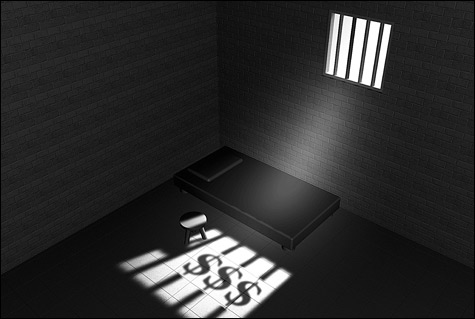
Cheney and former Attorney General Alberto Gonzales indicted for criminal conspiracy in private prison profiteering, resulting in prisoner assaults

By Brenda Norrell

WILLACY COUNTY, Texas -- US Vice President Dick Cheney was indicted today for a prison profiteering scheme and charged with abuse of prisoners. Cheney invested millions in the Vanguard Group, an investment management company with interests in the prison companies in charge of detention centers. Former Attorney General Alberto Gonzales was also indicted in the prison profiteering scheme, resulting in ongoing prisoner assaults and at least one murder.
Human rights activists urged a probe into prison profiteering after the private prison corporation GEO Group, began receiving enormous federal contracts to build detention centers to imprison migrants, including ones in Laredo, Texas and Jena, Louisiana.
Human rights activists said the fever-pitched racism mounted toward immigrants at the US/Mexico border was induced for the purpose of prison profiteering by US officials reaping enormous profits. The increased arrests of migrants resulted in profits and a long list of new prison construction contracts for the GEO Group, formerly Wackenhut, both with a long history of assaults and murders in prisons.
A Texas grand jury indicted Cheney today and accused him of at least misdemeanor assaults of inmates by allowing inmates to assault fellow inmates. Gonzales was charged with having used his position to stop investigations into assaults committed in a prison for profit in Willacy County, Texas. Both Cheney and Gonzales were charged with engaging in organized criminal activity.
Last month, a Willacy County grand jury indicted the GEO Group, on a murder charge in the death of a prisoner days before his release in 2001. The indictment alleged the GEO Group allowed other inmates to beat Gregorio de la Rosa Jr. to death with padlocks stuffed into socks. The death happened at the Raymondville facility. A jury ordered the company to pay de la Rosa's family $47.5 million in a civil judgment in 2006. The Cheney-Gonzales indictment refers to the de la Rosa case.
Human rights activists protested both Raymondville and Hutto prisons in southwestern Texas in recent years. At Hutto, migrant women and children were abused. ICE refused to allow a UN Rapporteur into Hutto.
During the Bush-Cheney regime, prisons of torture and prisons for migrants became synonymous with the name GEO, from Guantanamo to migrant prisons in the south and along the southwest border.

Cheney said Guantanamo was vital in 2005 and detainees could expect to be treated better here than "by virtually any other government on the face of the earth."
Geo was awarded a contract for the continued management of the Migrant Operations Center in Guantanamo Bay, Cuba, in Nov. 2, 2006. Recently, GEO received a contract for a migrant prison in Jena, La. GEO also received a contract for housing "criminal aliens" in the US, as stated on the GEO website.

GEO's migrant prisons were not restricted to the US. GEO also assumed a management contract in the Campsfield House Immigration Removal Center in England.
GEO was not the only one profiteering. The Wackenhut Corp. was also profiteering from transporting migrants from the border after their arrests. The two companies split in 2003.
All along the border, while GEO was building prisons, GEO's other half, Wackenhut Corp., was profiteering from the arrest of migrants from the borders.
The United States Customs and Border Protection agency entered into the contract with Wackenhut Corp., to transport arrested migrants from the border. Wackenhut is now the domestic subsidiary of the U.K.-based security giant Group 4 Securicor.
While the US filled its prisons with migrants, with a price on their heads, the number of Native American prisoners soared.
The US Department of Justice recently released a study showing that Native American inmates in Indian country jails increased by 24 percent between 2004 and 2007. The figures for Native Americans in all facilities -- tribal, federal and state -- increased 4.5 percent. Suicides, attempted suicides, deaths and escapes were cited as the result of deteriorating prison conditions.

Human rights activists hope the indictments of Cheney and Gonzales are the first of many indictments of the Bush-Cheney administration.

gonzoindict.gif

2008-11-17

What are prisons in Norway really like?

Erwin James visits Skien high security prison in southern Norway, and finds that behind the forbidding walls rehabilitation and education are key

Norwegian fjord

One of Norway's famous fjords. Photograph: Chris Lisle/Corbis

The entrance to Skien high security prison in southern Norway is as foreboding as any that might be imagined. The grey concrete walls are high and bleak – and appear even more austere against the backdrop of the blazing colours of the autumnal Norwegian forest close to which it has been built.

I have been invited to visit the prison by a teacher who works here. Leif, a gently spoken bear of a man, has been in teaching for more than 20 years – it runs in his family he tells me. "My father was a teacher," he says, "and so was my grandfather." I step through the Judas gate at the side of the main gateway and immediately I feel the weight of confinement. In the UK we call this part of a prison the "sterile area" - no prisoners allowed anywhere near it.

I follow Leif through other smaller steel gates as we make our way up a sloping, winding path that is bordered, perhaps a little incongruously, by flowerbeds and bright shrubs. An eerie peace hangs over the buildings. "The prisoners are all locked in their cells," explains Leif, "but they will be going out on the exercise yard soon, perhaps you would like to join them?"

It is an interesting suggestion, one I'm not too sure about at first. I remember my own time in prison and the discomfort that I and others felt when people from the outside came to "have a look around". It was fine if they engaged and interacted with us, recognising that we too were people. But when that didn't happen there was a real sense of intrusion, of being gaped at, as if we were animals in a zoo.

Meanwhile Leif takes me to the staff canteen. Prison guards are having a break, and a senior officer joins us, a broad-shouldered, tough looking man, with close-cropped hair and a clipped moustache. Leif explains that the man is the officers' union rep. He appears a little suspicious of me at first, but soon relaxes and we chat amiably. I tell him that in Britain we have a view that Scandinavian prisons are among the most progressive in Europe, "but what I've seen so far reminds me very much of the high security prisons that I have experienced at home". He smiles. "It's a prison," he says. "You would know it if you were in here."

Leif beckons me to follow him. "Come, I show you where I work," he says. I follow and soon we are in what I recognise as the education department. It is very clean. He shows me a classroom. There are rows of wooden desks and chairs, like any classroom, except each desk has a computer on it. "Every prisoner here has a computer in the classroom," he says, "and a computer in their cell."

The last bit especially surprises me. In the UK prisoner access to computers is strictly limited. Most education departments have a computer room – but only a dozen or so prisoners will ever be able to use them at any one time, bearing in mind that only 10-30% of any UK prisoner population has regular access to the prison education department. Leif tells me that there are 80 prisoners in Skien. In the whole of Norway there are just over 3,000 prisoners, out of the country's population of around 4m. "I don't suppose the prisoners have access to the internet," I say. Leif looks at me. "But of course," he says. And in their cells? "Yes."

Leif explains that firewalls have been set up to ensure security is maintained. "But they must be able to access the internet," he says, "to help in their education and also so that they know they are still connected to the world." It seems a noble and generous attitude compared to that in the UK. Few governors are prepared to allow prisoners have computers in their cells – and none allow Internet access for prisoners.

"Come," says Leif, "I'll show you the workshops." First we go to the woodworking shed. The machines are big and look complicated. "We train in all aspects of carpentry," he says. Then tells me that a prisoner manufactured all the desks, tables and benches that we have just seen in the classrooms in this workshop. "He is very proud of his work, and we are proud of what he has achieved," says Leif. Other examples of items being made by the prisoners are in various states of completion around the large airy room. "We want them to go back out into the community with skills," says Leif. He then takes me to the metal workshop where the same level of hi-tech machinery is evident.

Finally he takes me out on to the exercise yard where the prisoners are walking and jogging around in circles. They see us arrive and a number come over to meet us. They are surprised when I tell them I was in prison for 20 years and now work as a writer. We chat about how they are serving their time.

Ali, a former Kurdish guerrilla soldier, introduces himself. He says nice things about Leif. "He is good man," he says, "they help us here." Ali is studying for a law degree, which he intends to use to help his people when he returns to his home country after he is released. "But it is hard to keep motivated," he says. "Prison is difficult."

Even with the enlightened attitudes and abundance of facilities this place is still a prison. And it is not meant to be "easy". But at least here the prisoners are treated like men and provided with a constructive and meaningful regime. The differences between this and the impoverished UK system loom large. I shake Ali's hand and we seem to connect in some way. "Just don't give up," I say.

I thank all the prisoners for their time and wish them well on their journeys, and then I leave without turning to look back. I am aware of the huge privilege I now enjoy, of being able to enter a prison and walk out again the same day. Later I reflect on how far we have to go in the UK to even come close to matching the attitudes towards people in prison that I witnessed in Norway.

2008-11-10

Waiting to Die: The Cruel Phenomenon of "Death Row Syndrome"

By Michael J. Carter, IPS News. Posted November 7, 2008.

As prisoners across the country spend decades awaiting execution, the psychological effects are devastating.

SEATTLE, Washington, Nov 4 (IPS) — The length of time convicted murderers wait for their execution is steadily rising in the U.S., raising concerns that more will suffer from the mental illness known as "death row syndrome.”

The United States' 3,300 death row inmates can now expect to wait an average of 12 years from the day of their sentencing to death by lethal injection or electric chair, a doubling of the time gap in the mid-1980s, according to the U.S. Bureau of Justice.

This increase is mainly due to mandatory appeals introduced after capital punishment was reinstated by the Supreme Court in 1976 after a four-year suspension. These reforms have led to lengthier appeals, according to the Washington-based Death Penalty Information Center.

The 667 death row inmates in California can expect to wait nearly 20 years.

California's last execution was in January 2006. A month later, a judge halted the execution of Michael Morales, already on death row for 25 years, calling for measures to ensure no unnecessary pain during a state killing. The temporary moratorium put in place then has not yet been lifted.

In other death penalty states, inmates have also sometimes waited a quarter of a century or more to know the date of their execution, reprieve or exoneration.

On Sept. 16, Jack Alderman was executed in Georgia for killing his wife in 1974 after spending 33 years on death row.

In April, Renardo Knight had spent nearly 25 years on death row before his conviction was reversed due to evidence tampering.

Last year, Carey Dean Moore was moved from Nebraska's death row after waiting 27 years for the electric chair. The state's Supreme Court ruled this method of execution -- the only one on its statute books -- was unconstitutional.

Typically, death row inmates wait out the years for their punishment alone in solitary confinement, spending 23 hours a day in their cells. They are excluded from prison training and recreation programs. Visits and exercise privileges are restricted.

A few states, such as North Carolina, California and Georgia, allow varying levels of communication between death row inmates.

"There is a distinct syndrome associated with solitary confinement," Stuart Grassian, a psychiatrist and former professor at the Harvard Medical School of Psychiatry, told IPS.

In published research he has found that in the most sever cases this can lead to "agitation", "psychotic" and "self-destructive" behavior.

The healthy "often" became mental ill. There was a "severe" deterioration in the condition of those already mentally sick.

Grassian said the long appeals process of the condemned was "most worrisome".

"There is an enormous agony in endlessly, and helplessly, waiting while others decide whether you live or die.

"Generally, over time, the inmate learns he cannot afford to actually befriend his fellows; they keep disappearing into the death chamber. The horror of all that, the endless tedium and tension, often proves unbearable."

Rights activists say an illustration of the mental damage being done is seen in the case of Raymond Riles, on the Texas death row for the past 33 years. No execution date has been set because he suffers from delusions and paranoia. But in 1975, there were no mental health barriers in the way of his sentencing.

They also suggest "death row syndrome" may have played a role in the decision of 131 death row inmates since 1976 abandoning their appeals and "volunteering" for a quick execution.

"Many inmates in these circumstances cannot stand it any longer, fire their attorneys, drop their appeals, and hence "volunteer" for execution, said Grassian.

Seventy-five percent of these "volunteers" had a history of mental illness, according to John Blume, professor of law at Cornell University.

Rights activists have also raised concerns at the difficulties inmates with "death row syndrome" may face when their appeals succeed and they are given a lesser sentence and transferred to cells in the general prison. Only Missouri does not segregate death row inmates from the rest of the prison population.

The problems of adaptation and regaining their mental health may be more acute when they are exonerated and leave prison. So far this year, four death row inmates have been exonerated, bringing to 130 the number since 1973.

Experts question the reasoning behind the austere, often mentally damaging conditions on death row.

"The rational is that these inmates have nothing to lose and therefore they are potentially the greatest security risk," Grassian said.

But it had been proven that they were "less violent and disruptive than many other groups".

Ronald Tabak, a New York-based lawyer experienced in capital punishment issues, agreed.

"They tend to be less dangerous than other prisoners," he told IPS, adding: "There is no public sympathy for those who are sentenced to death."

Despite the growing debate about the "death row syndrome", the Supreme Court has yet to hear a case on the issue.

But two justices -- Stephen Breyer and John Paul Stevens -- have questioned the constitutionality of the long delays between conviction and the carrying out of executions.

The issue was "an important undecided one", Breyer said in 1995 during a ruling on the case of Clarence Allen Lackey. Lackey, who was executed in 1997, served almost 20 years on death row before his sentence was carried out.

So far this year, there have been 30 executions in the U.S., the most recent in Texas on Oct. 30.