Showing posts with label mexico. Show all posts

2009-02-18

At least our Mexican neighbors are still standing up for their freedom (and ours)

February 16, 2009: The government has 45,000 troops and 5,000 police battling several thousand cartel gunmen in 18 states. But most of the action is in a few states along the U.S. border. Two years of violence have left over 8,000 dead. The drug cartels are not strong enough to defeat the government, but they are determined to keep fighting to preserve their lucrative drug business. It’s all about ambition, greed and no inhibitions when it comes to killing. You can’t make this stuff up. The government is apparently going to keep at it until the cartels are destroyed, or adopt a much more low profile way of operating.

February 14, 2009: For the past three months Mexican and U.S. security officials have openly discussed increased U.S. support for Mexico in its war against drug gangs. This is being called, “the Cartel War”. The U.S. is concerned about “spill-over” violence. Politicians in El Paso, Texas, are worried about it, and they are concerned for their Mexican neighbors in Ciudad Juarez (Chihuahua state). Both Mexico and the U.S. are pushing “intelligence sharing” (intel on smuggling, drug gangs, weapons, finances, etc). One criticism from some sectors in Mexico is that intel sharing will likely lead to “American contractors” (meaning military or intelligence service companies). This is “contractors” used in a very negative sense, suggesting American mercenaries. Apparently the Mexican government thinks hiring expertise to support Mexican operations is a good option. Are joint operations by the U.S. and Mexico possible? Sure – but as both the U.S. government and Mexican government have stressed, such operations have to be very carefully planned and approved by both governments. At the moment Mexican-U.S. joint military operations are very unlikely, but it is a good bet that planning officers in Mexico and the U.S. are looking at “what can we do for each other” if cartels launch attacks in the U.S., or tried to create a situation where Mexican military units cross the border in the midst of a combat operation. Some joint operations well short of combat and “increased security presence” operations make a lot of sense. Joint communications operations are one example, and “joint liaison teams” manned by experienced military personnel from both countries another. You can bet any joint team will operate on both sides of the border. Political cover is one reason – Mexicans are sensitive to “affronts to sovereignty.” However, a “both sides” joint operation is also common sense since the violence and drug smuggling has transnational effects. Ad hoc arrangements and relationships already exist, but it appears both governments are interested in more formal and permanent cooperation.

February 10, 2009: At least 21 people died in a firefight in Chihuahua state (130 kilometers south of Ciudad Juarez) between Mexican soldiers and cartel gunmen. The confrontation began as a “stand-off” between soldiers and gang members who had kidnapped nine people. The gangsters executed six of the kidnap victims during the battle. Soldiers lost one of their own, and killed 14 gang members.

February 9, 2009: Troops took control of police headquarters in Cancun and arrested the local police commander and 36 policemen. The military announced that it believes the policemen are “connected” to the murder of retired Mexican Army Brigadier General Mauro Enrique Tello in Cancun.

February 5, 2009: Mexican soldiers and federal police participating in Joint Operation Chihuahua raided a drug warehouse in Ciudad Juarez. The police seized around two tons of marijuana.

February 4, 2009: A retired senior Mexican military officer, Brigadier General Mauro Enrique Tello, was murdered in Cancun in what authorities said was likely an assassination by a drug cartel hit team. Two bodyguards were killed along with the general. The murders were “execution-style”?the men were tortured then shot in the head. Tello had retired recently and after his retirement had take charge of a special counter-cartel security force authorized by the mayor of Cancun. Tello had also been in charge of operations in western Mexico in 1997 (Michoacan state) that amounted to a crackdown on drug traffickers and local gangsters – something of a “preview” of the Cartel War. The government is paying close attention to the murders, for several reasons. The Mexican Army plays a central role in the Cartel War – it is the government’s chief counter-cartel organization. Cancun is also an international tourist resort and a source of good jobs. Tourist revenues have declined since violence began increasing. So far the worst violence has been in northern Mexico, though the Acapulco region, which is also a tourist resort, has been plagued by inter-gang “turf wars” and shootouts between the police and drug gangs.

January 30, 2009: Demonstrators gathered in Mexico City to protest a government decision to “freeze” gasoline prices but not freeze prices for diesel. Most of the protestors were farmers who were complaining that the cost of farm machinery (most of the farm machines run on diesel) had increased prohibitively.

January 27, 2009: The government said 22 people were killed in northern Mexico over a 48 hour period. Four of the victims were killed at a PEMEX oil facility. They had “tape over their eyes” and they were shot in the head (more “execution-style” murders). Three more people were murdered in Chihuahua City.

January 24, 2009: The government reported thirteen people were slain in drug violence in the state of Chihuahua. Nine of the 13 were killed in the city of Ciudad Juarez (across the border from El Paso, Texas). A “semi-official” figure for murders in Chihuahua state during 2008 is now making the rounds: 2400. That means about 40 percent of the Cartel War deaths in 2008 occurred in Chihuahua state..

January 20, 2009: The U.S. Marine Corps is implementing new travel policies to Mexico for Marine Corps personnel. Marines stationed in Yuma, Arizona must get command permission before they cross the border (either on leave or off-duty pleasure travel). This is similar to the policies implemented by Ft Bliss, Texas, a U.S. Army post..The State Department has raised its “caution-level” for visiting Matamoros, Monterrey, Nogales, Tijuana, Nuevo Laredo, and Ciudad Juarez.

January 16, 2009: Is imitation the sincerest form of flattery? The Zetas have roots in the Mexican military and have operated as a para-military force. Now Mexican Army troopers have arrested three drug cartel gang members in Tijuana. The military report said that the gang members had “uniforms” with a patch featuring a skull and crossed crutches. A “gang faction” in the area is run by a gang leader who has the nickname “Muletas” (crutches). The men arrested were identified as being part of the faction’s “special forces.” Uniforms for cartel gunmen isn’t new – police and soldiers have found real military uniforms and modified uniforms in arms caches. “Paramilitary gear” also crops up in news and government reports, and that can refer to clothing as well as tactical gear. But it looks like at least one gang really wants to “play soldier.”

January 15, 2009: The U.S. Homeland Security Department said that it would send Border Patrol SWAT teams and even military units if “drug gangs” (term used in the report) crossed the U.S.-Mexican border and confronted U.S. police. Homeland Security stressed that this is “a contingency plan” only – implying local authorities (police, sheriff, state police) are the first responders to such an incident. The head of Homeland Security repeated this – that this is a plan, not a prediction. A senior official said the contingency plan can be “scaled” to meet the emergency, meaning that if local authorities only needed “back-up” (support) that would be made available, but if the situation escalated a larger rapid reaction force could be organized and sent.

January 14, 2009: The military said it was sending 2000 more army soldiers to Ciudad Juarez.

2009-01-22

Mexican Drug War Violence Is Going off the Charts

President-elect Barack Obama met Monday with Mexican President Felipe Calderón to discuss bilateral issues of major importance for the two countries. In addition to NAFTA and immigration policy, Mexico's ongoing plague of prohibition-related violence was high on the agenda.

More than 5,400 people were killed in the violence last year, and more than 8,000 in the two years since Calderón ratcheted up Mexico's drug war by sending thousands of troops into the fray. The multi-sided conflict pits rival trafficking groups -- the so-called cartels -- against each and the Mexican state, but has also seen pitched battles between rival law enforcement units where one group or the other is in the pay of the traffickers.

The Obama-Calderón meeting comes as the violence in Mexico is creating increasing concern among US policy and defense analysts. Last month, the National Drug Intelligence Center warned in its National Drug Threat Assessment 2009 that "Mexico drug trafficking organizations represent the greatest organized crime threat to the United States."

In a December report to the US Military Academy at West Point, former drug czar retired Gen. Barry McCaffrey warned dramatically that even the $1.4 billion, three-year anti-drug assistance plan approved by Congress and the Bush administration last year was barely a drop in the bucket, noting that it was only a tiny fraction of the money spent on the US wars in Iraq and Afghanistan.

"The stakes in Mexico are enormous," McCaffrey warned. "We cannot afford to have a narco state as a neighbor. Mexico is not confronting dangerous criminality -- it is fighting for its survival against narco-terrorism."

The consequences of US failure to act decisively in support of Calderón's drug war would be dire, McCaffrey warned. "A failure by the Mexican political system to curtail lawlessness and violence could result in a surge of millions of refugees crossing the US border to escape the domestic misery of violence ... and the mindless cruelty and injustice of a criminal state."

This week, the US Joint Chiefs of Staff jumped on the bandwagon. In their report, The Joint Operating Environment 2008, which examines global threats to the US, the Joint Chiefs warned that Mexico was one of the two countries most in danger of becoming a failed state. The other was Pakistan.

"The Mexican possibility may seem less likely," the report noted, "but the government, its politicians, police, and judicial infrastructure are all under sustained assault and pressure by criminal gangs and drug cartels. How that internal conflict turns out over the next several years will have a major impact on the stability of the Mexican state. Any descent by Mexico into chaos would demand an American response based on the serious implications for homeland security alone."

But for all the dire warnings of doom, the incoming president gave little sign that he would do anything other than stay the course. Nor did he suggest in any way that he would make a radical break with US drug policy on the border. Obama has stated publicly that he supports the Mérida Initiative aid package, and Monday he limited his public remarks to generalities.

Noting the "extraordinary relationship" between the US and Mexico, Obama added: "Not only did we talk about security along the border regions, how the United States can be helpful in Mexico's efforts, we talked about immigration and how we can have a comprehensive and thoughtful strategy that ultimately strengthens both countries."

Despite taking his first meeting with a head of foreign state with President Calderón and pledging renewed cooperation, and despite the chorus of cassandras crying for more action, analysts consulted by the Drug War Chronicle said that given the raft of serious problems, foreign and domestic, facing the Obama administration, Mexico and its drug war are likely to remain second-tier issues. Nor is the Mérida Initiative going to be much help, they suggested.

"Obama is busy with other pressing issues," said Sanho Tree, drug policy analyst for the Institute for Policy Studies, a Washington, DC-based think tank. "He just doesn't have the space and will to take on this other fight in Mexico."

On the other hand, the border violence frightening US policy makers is largely "a self-inflicted wound," Tree said. "Mix together high domestic demand here, prohibition economics, and a tough law and order approach, shake vigorously, and you have a disaster cocktail. It's not like we didn't warn them," he said.

Also, Tree noted, despite the rising alarm in Washington, there is little interest in opening a new front on the southern border. "Who has the stomach to take this on right now?" he asked. "Who is clamoring for this outside of institutional actors who want to protect their budgets? There is a lot of war-weariness and budget shock in this city, and that might leave some openings" for reform, he said.

"Probably not much will come of that meeting," said Tomás Ayuso, Mexico analyst for the Council on Hemispheric Affairs. "Calderón was pleading for Obama to put Mexico at the top of his list of priorities, but given what Obama is facing, the Mexican drug war is not at the top of his agenda."

Still, the situation in Mexico is serious and could get worse, Ayuso said. "If this isn't addressed now, Mexico could really descend into chaos. The drug cartels have virtually unlimited funding, their coffers are overflowing. The shadow economy in which they operate is booming, their operatives are armed to the teeth, and the next step is to set up a shadow government. It's very easy for them to influence people. They say: 'Accept our bribes or we'll kill you and your family.'" Ayuso said. "It's pretty effective."

"This meeting looked mostly like generalities, but Obama has said repeatedly during the campaign that he supports the Mérida Initiative, and that will most likely continue during his administration," said Maureen Meyer, Mexico analyst for the Washington Office on Latin America. "With more and more reports lately painting Mexico as a security crisis, we are seeing a recognition by the new administration that this is a priority, and it will continue cooperating with Mexico."

But the looming crisis on the border and in Mexico could provide openings for reform, Meyer said. "We hope to have more openings to reopen the debate on US drug policy internationally, and Mexico could give us the opportunity to look at what has and has not worked in the Andean region and Mexico as well," she said.

That debate could include modifications to the Mérida Initiative, which is heavily weighted toward military and law enforcement equipment and training, said Meyer. "Congress has reiterated its support for the Mérida Initiative, but we've also seen a tendency to redirect funding toward arms trafficking going south and demand here in the US. The Congress will also, we hope, start to look away from sending more equipment and toward more support for institutional reforms. Helicopters aren't going to have any impact on Mexico's underlying problems," she said.

The violence in Mexico could help further weaken already eroding support for US drug policy in the hemisphere as a whole, said Ayuso. "In Latin America, where most of the suffering is happening, many countries are asking whether the Washington-led war on drugs is the answer," he said. "That's something Calderón himself has brought up, but Obama is probably not going to budge on that. Still, the chorus is growing. More and more people want to re-evaluate the drug war."

2009-01-06

EZLN Criticizes the Drug War

During the Festival of Dignified Rage in Chiapas, Subcomandante Marcos breaks the EZLN's silence on the drug war

On the first day of the Zapatista National Liberation Army's participation in the Festival of Dignified Rage, its spokesperson Subcomandante Marcos discussed the drug violence that has increasingly plagued Mexico. Marcos' speech marks the first time the EZLN has addressed the drug war in any sort of depth.

Marcos couldn't avoid addressing drug violence in his discussion of violence against social movements. He says Mexican President Felipe Calderon and the corporate media "use and abuse the word 'violence'" for their own means. "They say they condemn violence, but in reality they condemn action." Marcos accuses Calderon of using the drug war to pacify discontent with his government. "Mr. Calderon decided that, instead of bread and circuses, he would give the people blood."

Referencing the lack of confidence in Calderon's government, which is ridden with corruption scandals and has failed to meet its own economic benchmarks, Marcos continued, "The professional politicians are the circus and bread is very expensive.... Perhaps...[Calderon's] goal is to distract people. The public is so busy with the drug war's bloody failure, it could be that it doesn't even notice Calderon's failure in political economy."

In his speech to Festival participants, Marcos verbalized what many Mexicans have long suspected: "Everyone who isn't in his Cabinet knows that he's losing this war, and that the death of his significant other was an assassination, which is also well-known but not ever published." The "significant other" Marcos refers to is Juan Camilo Mouriño, Calderon's long-time friend and Minister of the Interior until he was killed in a plane crash along with other officials. The Mexican government, which received assistance from US experts during the investigation, has ruled the crash an accident due to pilot error, but many Mexicans believe a drug cartel took down the plane. José Vasconcelos, Mexico's former top drug prosecutor, was also killed in the crash.

Marcos also verbalized the common suspicion that Calderon is using the military he's deployed around the country to support his preferred cartel while squashing the competition. Without mentioning specific cartels (Marcos always kept his drug violence criticism aimed squarely at the government), Marcos said, "Calderon decided, supported by one group of drug traffickers, to wage war on the opposing group of drug traffickers. Violating the Constitution, he deployed the military to carry out the duties of the police, the district attorney, the judge, the jailer, and executer."

Having accused the government of being on the side of at least one of the drug trafficking cartels, Marcos went one step further: "It becomes more and more clear that it's organized crime that directs the state's forces."

Marcos then went on to criticize the savage violence that Mexico is experiencing, which has taken the lives of pregnant women and children. Marcos compared this violence to other wars around the globe: "With Calderon at the front, the Mexican government goes a step beyond the US and Israeli governments: the Mexican government kills [civilians] beginning from when they're in their mothers' wombs."

2008-12-31

How to End The Violence Caused by Prohibition in Mexico? Ask a Federal Agent

The Los Angeles Times has a piece today containing suggestions from various officials for dealing with the extraordinary violence that has gripped Mexico since that country began pursuing a policy of aggressive drug prohibition. The most noteworthy remarks come from Terry Nelson, a Federal agent for 30 years with the U.S. Border Patrol, the Customs Service and the Department of Homeland Security. Nelson writes:

[E]ven with the best public health efforts, there will always be some who want to use drugs, and, as long as drugs are illegal, many willing to risk imprisonment or death to make huge profits supplying them. My years of experience as a federal agent tell me that legalizing and effectively regulating drugs will stop drug market crime and violence by putting major cartels and gangs out of business.

The Department of Justice reported [this month] that Mexican cartels are America's "greatest organized crime threat" because they "control drug distribution in most U.S. cities." If what we've been doing worked at all, we wouldn't be battling Mexican drug dealers in our own cities or anywhere else. There's one surefire way to bankrupt them, but when will our leaders talk about it?

2008-12-29

Freedom of the press as a foreign concept

A Mexican reporter who wrote about drug violence in his homeland is being held in custody by none other than the U.S. government and its immigration service.
By JAMES RAINEY
December 28, 2008
Yes, we reporters might get stuck covering the late shift or -- egad! -- a parade. When disaster strikes or a source calls back on deadline, the nights can be long. Newspaper layoffs and hard economic times can cast a pall over just about everything we do.

But those concerns seem a piffle every time I read dispatches from around the world about journalists who, fighting for the story, also must fight for their lives.

The day before Christmas, an international group condemned the protracted torture of a journalist in Pakistan. And militant Maoists ransacked the offices of an opposition newspaper in Nepal. Its crime? Using acronyms for two of the militant groups without distinguishing between them.

A couple of days later, news arrived that Zimbabwean journalist and human rights activist Jestina Mukoko had been accused of plotting to overthrow the government. Mukoko -- already in custody for challenging Robert Mugabe, the thug who runs her country -- could face death.

Sadly, real press freedom remains elusive even closer to home, as revealed by another story just over our southern border.

Two days before Christmas, a 15-year-old Mexican boy held a news conference in El Paso to detail how his reporter father had been held -- without charges -- for six months. The perpetrators were not shadowy foreign agents or some sketchy dictator, but the United States government and its immigration service.

The story grows out of the drug violence that has beset Mexico and left more than 5,300 people dead this year. Since 2000, 44 journalists have been killed in Mexico, many of them targeted for writing about the drug gangs that dominate the country.

The military crackdown on the drug lords has created its own problems. And that's what brought reporter Emilio Gutierrez Soto of El Diario del Noroeste into the story.

In 2005, he wrote that some soldiers were drunk when they raided a hotel in northern Chihuahua state. Other stories reported alleged thievery by the military. Last spring, a squad of soldiers and their commanding officer invited Gutierrez to a restaurant in his hometown of Ascension. They told him he would pay with his life if he continued. They ordered him not to tell anyone about the meeting.

Gutierrez, 46, promptly wrote another story, in which he recounted the alleged death threat. A few nights later, he said, a pounding on the door awoke him and his son.

Some 50 soldiers, wearing masks, ripped through the house, claiming they were looking for drugs and illegal weapons, he said.

The soldiers didn't find anything and left, Gutierrez said. After, a friend of one of the soldiers warned him that the next visit would be the last.

Gutierrez, the sole supporter of his son, decided he could not wait. On June 15, the reporter and his boy crossed the Rio Grande and into the land of the 1st Amendment, turning themselves in to immigration officials and pleading for asylum.

Immigration and Customs Enforcement officials took father and son into custody and sent them to a detention center in El Paso.

The U.S. has rejected asylum requests from several other Mexican journalists who said they feared for their safety. But Gutierrez said he believed he could prove he had a real and credible fear for his personal safety in his home country.

The bitter irony -- according to his lawyer, Carlos Spector -- is that by presenting himself as an "arriving alien," the reporter was not entitled to the judicial hearing that an illegal crosser would have received.

ICE's request to postpone his hearing until March means that Gutierrez will have waited nine months to plead his case.

So he sits and waits, missing his freedom and his son (who was released to family friends in the U.S. after a couple of months in custody). He wonders how he can make a new start, if he gets the chance.

"I am not a criminal," the reporter said in a telephone interview last week. "I am a journalist."

U.S. officials, Spector said, have called Gutierrez a "threat to the community" but offered no evidence. "They can't even come up with a rationale," Spector said. "They don't even try."

An ICE spokeswoman declined to comment, citing Gutierrez's privacy and the pending hearing.

Spector theorizes that the U.S. government is loath to offer relief to a journalist who has raised doubts about the Mexican military's conduct. That would embarrass an ally and trading partner.

Even if he could be released back to Mexico, Gutierrez said, he would not want to go, fearful about his safety and of leaving his son behind. "I love my country, but I can't go," he said. "Because if I do, I'm going to die."

Another El Diario reporter was shot to death last month outside his home in Ciudad Juarez, across the border from El Paso. An online newspaper editor at the funeral received a cellphone call: "You will be next."

Reporters Without Borders, an international nonprofit that advocates for journalists, has spearheaded attempts to win Gutierrez's release. The Catholic bishop of El Paso last week lent his voice to the campaign.

It would be nice to believe our government is trying only to protect us. But it's hard to imagine what's taking so long to decide Gutierrez's fate -- or what would warrant holding a reporter for so long, without the chance to plead for his freedom.

In the meantime, the U.S. government has pledged that it wants to help Mexico win its war on drugs and corruption.

A good way to start would be to protect the journalists who have risked their lives to help the public understand a sad, sad state of affairs.

james.rainey@latimes.com

2008-12-21

Fort Huachuca soldiers restricted from Mexico

[ This is probably a good idea. American "soldiers" are not likely to be wanted there (anymore than they are here), and certainly are too pansy to be capable of dealing with the expressed, uh, rejection of serious and capable people, fighting for their freedom in the war you started. ]

TUCSON, Ariz. — The Army is tightening restrictions on soldiers stationed at Fort Huachuca who want to travel to Mexico because of rising violence south of the border.

The nearly 7,000 troops based at the southern Arizona post now must receive permission from a top commander before traveling to Mexico, base officials said. Another 11,000 or so family members, civilian staffers and contractors at the fort are “strongly urged” not to visit Mexican cities such as Naco, Agua Prieta and Nogales, a popular shopping, dining and nightlife destination.

The Army can’t legally stop family members and civilian workers from visiting Mexico, but it is warning them not to do so for their own safety, said Tanja Linton, a spokeswoman for Fort Huachuca. The post is about 75 miles southeast of Tucson and less than 20 miles from Mexico.

“We are constantly monitoring this situation in the interest of protecting our people,” Linton said.

Fort Huachuca’s travel restrictions, put in place on Tuesday, are less severe than those at Fort Hood in Texas, where soldiers are banned outright from traveling to numerous Mexican border cities. Travel restrictions are set by installation commanders and vary with local conditions, Linton said.

Drug cartel-fueled violence has reached unprecedented levels this year in the state of Sonora and specifically in Nogales. Mexican President Felipe Calderon’s campaign to weaken the cartels by putting federal and state police along known drug-smuggling routes and trying to snuff out corruption has added fuel to the fire.

Recent bloodshed has landed Nogales on the U.S. State Department’s Mexico travel alert.

One tourism operator in Tucson said the Army’s new travel restrictions likely will add to public fear of travel to Mexico.

“Anytime you’ve got the government and press telling people it’s unsafe, most Americans are going to err on the side of caution,” said Mike Huhn, owner of Desert Divers, which leads scuba-diving and snorkeling excursions to San Carlos, Sonora.

The director of the Sonora Office of Tourism called the Army action worrisome and took exception to the notion that tourists are in danger. The killings are occurring between drug cartels and law enforcement, he said.

“Not one single tourist has had problems in the state of Sonora,” Epifanio Salido Pavlovich said. “And we are going to great efforts to make sure no one is affected.”

2008-12-09

Juarez murders shine light on an emerging 'Military Cartel'

America’s drug war has made murder a growth industry in Juarez, a sprawling Mexican border town of some 1.2 million people located a stone’s throw from the Texas city of El Paso.

The growth of this industry is measured in corpses and coffins. Some say the number of murders in Juarez so far this year exceeds 1,400, but no one really knows for sure, because not all the corpses have been found, so they can’t all be counted.

In recent weeks, the U.S. media has added a new subplot to its time-tested narrative explaining the bloodshed sparked by the narco-trafficking business — an enterprise valued at as much $500 billion globally, according to the United Nations, with up to a quarter of that business flowing through Mexico to feed the U.S. drug habit.

Again, no one really knows the true size of this enterprise, because it is hidden in the shadows, but few could argue against the reality that the flow of money from illegal drug sales is helping to prop up the economy of Mexico — and the bank accounts of both legitimate and illegitimate businesses on both sides of the border, since that money spends like all other money.

The baseline of the media narrative explaining the carnage in Juarez goes something like this: The death count in Juarez is the result of a bloody turf war being waged to control the critical narco-exporting port of Juarez. This street battle has sparked a shootout between rival drug “cartels” — headed by quasi-mythical figures like Joaquin “El Chapo” Guzman Loera and Vicente Carrillo Fuentes — who are now in retreat due to the Mexican President Felipe Calderon’s decision to use the military to defeat them and return law and order to Juarez and Mexico in general.

This narrative is so convincing that the United States is prepared to commit some $1.5 billion over the next few years, under its Merida Initiative (also dubbed Plan Mexico), to provide training and equipment (including sophisticated surveillance technology and aircraft) to Mexico’s law enforcers and its military to assist Calderon in his battle against these criminal cartels.

The latest twist in this plot reveals that these ruthless drug cartels are now ratcheting up the violence due to the flow across the border of thousands of weapons — high-powered rifles, machine guns, cop-killer ammo, even grenades — from the U.S., all enabled by lax U.S. gun laws and enterprising criminals on both sides of the border.

But is it really that simple? Well, the devil is always in the details, it seems.

Narco News recently obtained a thorough accounting (really a police blotter) detailing all of the murders in Juarez between Jan. 1 and July 10 of this year — information compiled by U.S. federal law enforcers and leaked to Narco News by a source who prefers to remain anonymous. In addition, Narco News also was leaked a law-enforcement-sensitive PowerPoint presentation prepared by the DEA, which outlines the agency’s assessment of the escalating drug-war violence along the border.

An analysis of this “police blotter” by Narco News, coupled with data from the PowerPoint, turned up some interesting patterns that don’t fit neatly into the existing media narrative about the drug violence in Juarez. But you, kind read, will have to be the ultimate judge of what these numbers mean.

I hope, at this point, I still have your attention.

Powderburns

Celerino “Cele” Castillo III is a former DEA agent who played a key role in exposing the U.S. government’s role in narco-trafficking as part of the Iran/Contra scandal.

Castillo subsequently, after a 12-year career, retired from the DEA, but to this day he has remained an outspoken critic of the hypocrisy of the war on drugs, penning a book about his experiences in DEA, called Powderburns, and appearing on numerous radio and TV shows.

Recently Castillo, a decorated Vietnam veteran who has no prior criminal record, was convicted of dealing firearms without the proper license and sentenced to 37 months in a federal pen. (See prior Narco News story on Castillo’s case here.)

Several law enforcement agents who spoke with Narco News are convinced Castillo was targeted, even framed, by elements of the U.S. government — specifically, corrupt agents — because he was digging into matters that ruffled the wrong feathers.

One of Castillo’s discoveries, in particular, likely incurred the wrath of a particular federal agency, the Bureau of Alcohol, Firearms and Tobacco (ATF), Castillo claims. As part of his part-time work as a consultant on criminal cases, Castillo contends that he uncovered evidence that two ATF agents “were on the payroll of a Mexican cartel.” That “cartel,” Castillo asserts, is a paramilitary offshoot of the Mexican military that is being supplied with U.S. weapons, some only available through the U.S. military, by operatives on the U.S. side of the border. (The use of weaspons smuggled in from the U.S., as opposed to employing Mexican-issued firearms, provides for a convenient arms-length excuse should they be recovered by the wrong parties in the course of operations.)

Castillo also points out that ATF was the agency responsible for building the gun case against him and that one of the alleged corrupt ATF agents involved with this Mexican paramilitary unit assisted with the case against him. Now that he has been convicted of a crime — Castillo’s case is on appeal — he can be discounted and his allegations discredited, or so the theory goes in such matters.

But Castillo’s allegations, if investigated and verified, could prove to be extremely explosive and even threaten the underpinnings of U.S./Mexican relations and the very premise of the drug war.

Here’s what Castillo told Narco News:

During the presidential elections, El Chapo [Joaquin Guzman, leader of the Sinaloa drug trafficking organization, or DTO] supported [Mexican President] Calderon. Calderon then rented the military to El Chapo to take out Osiel [Cardenas Guillen, leader of the Gulf DTO, which controlled the Mexican border town of Nuevo Laredo]. Keep in the back of your mind, why has Chapo not been arrested?

Calderon took back the military and is now working hand in hand with El Chapo. … [U.S.] Iraq [War] veterans were acting as mercs for the Mexican military. Right now, as we speak, there are U.S. Iraq veterans work ing for this organization. They are doing the enforcement work on this side [of the U.S. border] for the Mexican military. They are collecting the … profits of drug sales in the U.S. They [targets who owe money to the drug organization] are grabbed and given 24 hours to wire some of the money into Mexico bank accounts. If not, they are executed. ...

The old M-79 grenade launcher uses the 40 mm round. The ones that were laying on the table in the picture [see photo below of weapons confiscated by Mexican authories] of today’s paper. What the story is not telling is these 40mm [rounds] are U.S. military issued. How about them apples?

Castillo adds that he recently was provided information that indicates another group made quite famous by the media, the Zetas (a U.S.-trained Mexican special operations group that defected from the Mexican military) is now assisting the Mexican military in its narco-trafficking operations along the border.

If you follow the mainstream media narrative to date involving Calderon’s drug war initiative, the Zetas have cropped up being aligned initially with the Gulf DTO (drug trafficking organization), when Calderon sent troops into Nuevo Laredo in 2007 to restore law and order. That same year, media and DEA reports indicated the Zetas were in Tijuana, another critical border port of entry, working in the interest of the local DTO in that city. More recently, reports indicate the Zetas have popped up in Juarez, aligned with that city’s local DTO and a break-away faction of the Sinaloa DTO.

If you have a hard time keeping it all straight, don’t fret too much; it’s supposed to be confusing.

The media narrative across all three major Mexican border cities — Nuevo Laredo, Tijuana and Juarez — where thousands of Mexican soldiers have been dispatched by Calderon last year and this year to fight the “cartels” seems to have one consistent pattern, though, almost as though it is designed to aid the propaganda of his drug-war assault.

The elusive Chapo Guzman pops up challenging the local DTO in the border city. Then the Zetas pop up, aligned with the local DTO, which employs corrupt elements of the city and state police forces as enforcers. Violence begins to escalate as Guzman’s forces attempt to battle the local DTO, cops and Zetas for turf.

Calderon then sends in thousands of Mexican troops, disarms or otherwise wrests power from the local cops (who also, in all three cities, are subsequently the targets of assassinations as this all plays out) and the violence in the cities actually escalates even further — until, as in Nuevo Laredo, there are simply fewer people in the local business left to kill.

However, it’s never really made clear where Guzman is getting his manpower from to fight this war across the 2,000-mile-plus stretch of the U.S./Mexican border, but it’s just assumed that he uses his money to buy a mercenary force. Have the Zetas really worked for Guzman all along, or factions of them; or are they only now realizing Guzman is winning the war, and are switching sides; or are they simply die-hard mercenaries who will play for the highest bidder?

No one can really say for sure unless they are involved, but they do not seem to be a particularly loyal sort, except to their own interests. That might explain why last year Calderon set up his own private military unit, which reports directly to him, numbers at least 3,500 and was culled from the same Mexican special ops units that gave birth to the Zetas.

Now, whether we believe Castillo’s take on all of this, which he says is based on intelligence he has gathered, an expertise honed by his years as a law enforcer in conflict zones in Latin America, is really a matter of individual choice. But several other federal law enforcers who spoke with Narco News, on the condition their names not be used, don’t find his analysis to be far-fetched.

“The Mexican military and government are corrupt,” one law enforcer says. “The Military escorts smugglers to the border. It’s a daily occurrence. The video cameras at the El Paso Intelligence Center have it all on video, filed away. If we report the suspicious activity to our superiors, nothing ever happens. It’s just covered up.

“The Mexican military cartel has taken over Juarez. Our government knows it; they’re not stupid, but they’ve made some backroom deal with the Mexican government.”

Another federal law enforcer who spent years in Latin America puts it this way:

Ever since I can remember, every government in Mexico has been dirty. Usually, a new president comes in and makes noise about cleaning things up, and before his term is up, he’s making money off the corruption.

Recent Mexican media reports have revealed that the federal law enforcement ranks in Mexico are replete with narco-corruption. In fact, one of Calderon’s cabinet members, Secretary of Public Security Genaro Garcia Luna, is described in a recent story in the Mexican news magazine Proceso [translated here by Narco News’ Kristin Bricker] as a “spoiled official,” untouchable, despite numerous allegations that he and officials under him have links to the Sinaloa DTO.

From Bricker’s translation of the Proceso story:

With his powerful tentacles and his ability to corrupt police and infiltrate the institutions responsible for combating drug trafficking -- including the National Defense Department [emphasis added] -- Ismael "El Mayo" Zambada Garcia [of the Sinaloa DTO] has extensive control within the Public Security Ministry (SSP in its Spanish initials), which is led by Genaro Garcia Luna, whose main collaborators -- some of them currently held under administrative detention -- are accused of being at the service of the man who today is considered to be the top boss of the Sinaloa cartel.

The informant, Guillermo Ramirez Peyro, a former high-ranking member of a Juarez DTO cell who was at the center of the infamous House of Death case — which involved the torture and murders of a dozen people in Juarez with the assistance of the informant under the watch of U.S. federal agents — describes the Juarez DTO’s relationship with Mexican law enforcement and the military, as it existed in the early 2000s, as follows (in testimony he gave in immigration court in the U.S.):

Yeah, the police, the cartel, the government, it’s all the same people. … Well, the cartel [the Juarez DTO] had arrangements with people that were close to President Fox [of Mexico]. He [Ramriez’ boss, Juarez DTO cell leader Heriberto Santillan Tabares] explained to me that President Fox took, took the position to arrange, consult with the cartel from Juarez to — which it, which it means that he was going to attack the, the enemy cartels being from Tijuana and from the Gulf, and then the cartel from Juarez would be operating with this court, you know, without the government being — on top of them.

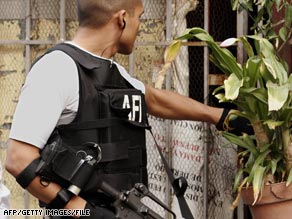
... Also, when I did go to Colombia to make arrangement with the Colombians, the plans was to come by sea, and the Mexico's navy, the ships, they're the ones that would get the drugs in the, in the sea - marina - ocean borders, you know, of the national territories. … and the PGR [the Mexican Attorney General’s Office, which oversees AFI, Mexico’s federal police now under the effective control of Garcia Luna, Calderon’s Public Security Minister] then would fly this drugs to the - to Juarez, the city of Juarez.

So, if we are to at least consider any of the above evidence, it seems the existing media narrative about the drug war, and the violence in Juarez, is lacking, since it assumes the Mexican government, and Calderon, are playing by the rule of law. And at least when it comes to the Mexican military, it’s clear DEA does not buy that assumption. The DEA PowerPoint leaked to Narco News includes the following information to demonstrate that reality:

Between Jan 2000-Dec 2006: More than 163,000 military members were criminally processed during former president Vicente Fox’s 6 years term of office. The majority of the crimes were: [the list includes abuse of power, homicide, embezzlement, kidnapping, bank robbery, illegal possession of firearms and health crimes [essentially organized crime].

Another slide in the PowerPoint provides this analysis:

• DTOs will further reach out to the Mexican military and foreign paramilitary and possible insurgent organizations in order to acquire much needed human and material support to fend off advances by competing Cartels.

• The result will be the emergence of a new type of drug trafficking organization in Mexico and the US precipitating a general militarization of the DTOs.

Now, ask yourself, how is it possible that Calderon has sent some 40,000 Mexican troops into the field to combat narco-trafficking, 2,500 or more dispersed to Juarez alone, yet the violence continues to escalate under the watch of this massive military force, DTO leaders like Guzman still roam free, and the flow of drugs into the U.S. (a multi-billion dollar business where apprehending a couple hundred million dollars worth of narcotics a year represents little more than a tolerable tariff) remains largely unchecked.

Common sense seems to dictate that something is awry with Calderon’s game plan (and the U.S. plan to send his government some $1.5 billion worth of special training and equipment via Plan Mexico) — leaving aside the question of whether Calderon is simply a fool who doesn’t have control of his own military or is actually complicit in the corruption.

Iraq Comes Home

Castillo’s charge that “Iraq veterans” are on the payroll of the DTOs, acting as enforcers and helping to fuel the violence in Juarez by moving weapons — including U.S.-issued munitions — from the U.S. into Mexico (which has very restrictive gun laws) might seem over the top at first glance.

But as Narco News checked into the allegation, federal agents directed us to another law-enforcement-sensitive report that apparently was not well received by the U.S. Department of Defense. The law enforcers indicate that the report sheds some light on Castillo’s allegations concerning the Mexican DTOs’ reach into the U.S. military itself.

The report [link here] was issued last year by the National Gang Intelligence Center, which serves as an intelligence bank for local, state and federal law enforcement agencies in the U.S.

Following are some highlights from the report:

• Members of nearly every major street gang, including the Bloods, Crips, Black Disciples, Gangster Disciples, Hells Angels, Latin Kings, The 18th Street Gang, Mara Salvatrucha (MS-13), Mexican Mafia, Nortenos, Surenos, Vice Lords, and various white supremacist groups, have been documented on military installations both domestically and internationally.

Gang members may enlist in the military to escape their current environment or gang lifestyle. Some gang members may also enlist to receive weapons, combat, and convoy support training; to obtain access to weapons and explosives; or as an alternative to incarceration. Upon discharge, they may employ their military training against law enforcement officials and rival gang members. Such military training could ultimately result in more organized, sophisticated, and deadly gangs, as well as an increase in deadly assaults on law enforcement officers.

• Gang members in the military are commonly assigned to military support units where they have access to weapons and explosives. Military personnel may steal items by improperly documenting supply orders or by falsifying paperwork. Law enforcement officials throughout the United States have recovered military-issued weapons and explosives — such as machine guns and grenades — from criminals and gang members while conducting search warrants and routine traffic stops

• According to open source reporting and multiple law enforcement reporting, soldiers — including gang members — are currently being taught urban warfare for combat in Iraq, including how to encounter hostile gunfire.

Some case examples from the report:

• In June 2006 an incarcerated US Army soldier and active gang member identified 60 to 70 gang-affiliated military personnel in his unit allegedly involved in the theft and sale of military equipment and weapons. The solider reported that many of the military personnel in charge of ammunition and grenade distribution are sergeants who are active gang members. The soldier also reported that military commanders were aware of the actions of these gang-affiliated personnel

• In August 2005 a US soldier in San Antonio was suspected of supplying arms — including hand grenades and bullet-proof vests—to the Texas Mexican Mafia (Mexikanemi), according to uncorroborated but reliable FBI source information

• Since 2004, the FBI and El Paso Police Department have identified over 40 military-affiliated Folk Nation gang members stationed at the Fort Bliss Army Installation in Texas who have been involved in drug distribution, robberies, assaults, weapons offenses, and a homicide, both on and off the installation.

So, it seems there is a pool of labor available, in addition to U.S. black-ops private contractors, to put in place a U.S. network of military trained enforcers and weapons smugglers, as Castillo alleges already exists and is currently assisting the “military cartel” in Mexico.

The Police Blotter

And what do the murder stats in Juarez show?

After all, if the Mexican military is now the major force behind the narco-trafficking business along the border, then we should see some signs of its operations in those statistics, right?

Narco News ran the numbers from the U.S. law-enforcement accounting leaked to it by a source who cannot be named. You can do your own analysis of the data, which is available at this link.

The data included names, dates and narratives about each incident and victim; however, in some cases, due to insufficient information about some incidents, the identity of the victim or the precise nature of the crime cannot be determined.

Following is what our analysis found.

Between Jan. 1 and July 10, the period covered by the data, there was a total of 473 victims in Juarez, of which 412 were murdered, 50 survived (though some may be dead by now), and 11 individuals were identified as kidnap victims. Those victims show up in a total of 352 separate crime incidents over the period covered (which means some incidents involved more than one victim).

Based on the cases where the identity of the murder targets could be determined, the average age of the victims was 31.7, though they ranged in age from 1 to 68, with 163 being age 30 or younger; 257 were age 39 or younger.

A total of 9 murder victims were identified as women, about 2 percent of all murders. Another 4 women survived murder attempts.

A total of 40 Mexican law enforcers were targets over the five-month period — of which 29 were killed, 7 survived and 4 are missing. Three ex-cops also were murdered; one Mexican Customs agent; three attorneys; one journalist; and, most interesting, only one soldier, a military officer. It would seem if the military was truly battling the “cartels” in Juarez, the casualties on that front should be much higher, no?

Since Calderon sent the military into Juarez in late March 2008, the murder toll in the city has jumped dramatically. The data obtained by Narco News shows the death toll on a steady climb from 18 in January — and after a slight lull in April — to 119 in June (see chart). The murder figure for November, according to Mexican news reports, hit 192.

Some additional data worth mentioning:

• About a dozen incidents involved victims whose vehicles had U.S. plates.

• More than 20 incidents, where witnesses were willing to talk, involved multiple vehicles coordinating in an assault on a victim or victims; armed commandos, masked men or men in black, or a group of armed men.

• About five of the murder victims were identified as Aztecas [a gang with El Paso roots that is allegedly aligned with the Juarez DTO), including one described as a “captain.”

• At least 14 incidents involved a note left on the body, most signed by “La Linea” and referencing Chapo Guzman, or words to the effect that the person killed was a snitch: ie. “X dedo and banado” [finger washed/snitch killed] or “Este Mensaje es para los siguen creyendo y para los que no la creen, sigan hacienda caso al Chapo Guzman que solo les garantiza la muerte, bola de pendejos. La Linea” [THIS MESSAGE IS FOR THOSE THAT KEEP BELIEVEING AND FOR THOSE WHO DON’T BELIEVE. LISTENING TO CHAPO GUZMAN WILL ONLY GUARANTEE YOUR DEATH, YOU BUNCH OF IDIOTS. LA LINEA]

Interestingly, not a single body note surfaces referencing the Zetas, nor anything in the any of the crime incident narratives refers to the group; also, there are no notes found on bodies from Guzman/Sinaloa DTO-affiliated groups working against La Linea.

La Linea is the "Juarez Cartel," specifically the local cops who work as enforcers, and they are now allegedly, according to the media script, working with the Zetas against Chapo Guzman and the Sinaloa Cartel, with the Mexican military playing the good-guy role of Über policeman.

The media has advance a similar script for the narco-violence in Nuevo Laredo [there involving the Zetas/Gulf cartel vs. Guzman’s Sinaloa organization] and in Tijuana — there involving a cluster-gang war between the Tijuana DTO led by the Arrelano Felix family, the Zetas and Guzman’s Sinaloa organization. Calderon’s Mexican troops were brought into the mix in both border cities as of early 2007.

From the DEA PowerPoint leaked to Narco News:

• June 2007. DEA Intelligence reported ZETA representatives in Tijuana and will commence kidnapping/killing of ... Police Officers aligned to Sinaloa Cartel.

• Under guise of assisting NWDTO [the Arellano Felix organization], once in place they will ignore the NWDTO, take over the territory, and continue their battle against the Sinaloa Cartel.

Again, in this script, we are asked to ignore the fact that these internecine battles between rival cartels are playing out under the watch of thousands of Mexican troops in each of these border cities, with the drug trade continuing largely unabated as the murder count rises and the “cartel” leadership remains — other than the occasional sacrificial lamb to appease the U.S. — still in place operating the business.

More Data

Narco News was able to analyze a total of 256 incidents from the Juarez murder data leaked by the source. The narratives accompanying those incident reports (from which we excluded the Mexican police assaults) provide enough information to determine the circumstances of the murders or murder attempts. (See chart.)

That incident analysis was broken down into six major categories, as follows:

Vehicle: Murder attempts involving victims in or near vehicles, most while driving in Juarez and attacked by gunmen in vehicles.

Sample narrative from murder report:

The victims were driving a green convertible Cutlass when they were being followed by two vehicles with a group of armed men. The vehicle wrecked at Municipio Libre and 5 de Febrero against another vehicle. The front passenger exited at which time the armed men shot him. The driver then exited and he also was shot dead. An innocent woman looked out her house and was shot in the abdomen.

Street: Shot or found dead on the streets of Juarez.

Sample narrative:

The three victims were found shot dead at 4063 Bahia and Montevideo in the Colonia Industrial. Witnesses said that the victims were shot by eight masked armed men that were driving a white station wagon.

Tortured/bodies found various places: Bodies were discovered showing signs of torture. This is typically a sign of DTO enforcement activity — informants or others killed for violating the rules of the DTO or in some other way crossing them. If victims fell into this category, they were not counted in other categories, regardless of where their bodies were found.

Sample narrative:

Two decapitated victims were found at Lazaro Cardenas and Hermengildo Luna in the pueblo of El Sauzal Nuevo. The bodies were found wrapped in blankets and the heads in black plastic bags. One of the heads was found three blocks away apparently taken by a stray dog.

Business: Shot at a place of business, primarily bars and restaurants, often involving a group of armed/masked men.

Sample narrative:

The victims were shot while inside the Club 16 located at 16 de Septiembre and Constitucion. The victims were gunned down with an AK47 and .308 rifles. The witnesses said that the two armed men were dressed in black and had their face covered.

House: Victims were attacked in or near a residence.

Sample narrative:

The victim was gunned down at his house by an armed commando who threw grenades and gas grenades into his house. The victim lived at 2312 Bosque de Granados. Forty two casings of 90 calibers, .308 calibers, and .223 calibers were found at the scene.

Parking/vacant lot: Victims were attacked or their bodies were found in an open lot.

Sample narrative:

The body of a male victim was found in an empty lot located at Manuel Talamas Camandari. The victim was shot. Several 9mm casings were found at the scene.

The one clear pattern that emerges from the data is that the murders in Juarez are, in almost all cases, not the result of random violence or shootouts between rival drug gangs. In most cases, they are cold-blooded assassinations, often involving coordinated teams of armed, sometimes masked, men who are making use of intelligence, surveillance and paramilitary-like tactics to take out their victims.

And those doing the dying don’t appear to be the military or the leadership of the DTOs, but rather DTO foot soldiers, snitches and occasionally innocent victims who happen to be in the wrong place at the wrong time. In that kind of environment, political targets (those who happen to be burrs in the saddle of government officials) also could easily be in the mix.

One federal agent who reviewed the data for Narco News had this to say about his take on the Juarez bloodshed:

They’re anything but random acts. Some of these murders are likely the result of cartel turf battles, but the numbers seem to high for the cartels alone. I don’t think they would be killing each other at that rate.

So if this is not as the media script depicts it, a turf war between the Juarez and Sinaloa “cartels’ alone, then who is responsible for all the killing. Could Castillo be right. Is Juarez a city in the grips of a death-squad campaign being carried out by paramilitary operatives of a corrupt Mexican military seeking to corner the narco-trafficking business, with the acquiescence, maybe even complicity, of the Mexican government — and with our own government now set to support this bloodshed through its funding of Plan Mexico?

That is for you to decide. Castillo, for his part, has already made up his mind, it seems:

These people are part of President Calderon's people who control the drug trade into the U.S.

Castillo may soon be forced to survive with that truth in prison, where his government now wants to send him, where it sends both victims and predators in the drug war to assure the continuation of its script.

Stay tuned….

Apartheid: US takes Israel's lead, spying and killing at borders

By Brenda Norrell

TUCSON -- Border towers and automatic killzones are already a reality in Israel and could be the next step for the US/Mexico border. Meanwhile, an unmanned and malfunctioning Predator drone is headed for the US/Canadian border from the US/Mexico border to endanger lives there.

The drones, unmanned spy planes, were discontinued for a while after one crashed near Nogales, Ariz., in 2006. Congress, however, brought back the drones, equipped with lasers, to endanger lives on the ground again. The Predators are also used by the US to kill people in Iraq and Afghanistan, controlled by US soldiers in Arizona and Nevada.

Now, Noah Shachtman writes in WIRED that the US government has been trying with limited success to install a string of sensor-laden sentry towers at the US/Mexico border. In Israel, these towers have automatic weapons to spray death.

"On the U.S.-Mexico border, the American government has been trying, with limited success, to set up a string of sensor-laden sentry towers, which would watch out for illicit incursions. In Israel, they've got their own set of border towers. But the Sabras' model comes with automatic guns, operated from afar," Shachtman writes.

The Sentry Tech towers are basically remote weapons stations, stuck on top of silos. "As suspected hostile targets are detected and within range of Sentry-Tech positions, the weapons are slewing toward the designated target," David Eshel describes over at Ares. "As multiple stations can be operated by a single operator, one or more units can be used to engage the target, following identification and verification by the commander."

Wired said it flagged the towers last year, as the Israeli Defense Forces were setting up the systems, designed to create 1500-meter deep "automated kill zones" along the Gaza border.

Meanwhile, the US now has a Predator drone on the way to patrol the northern US border. It comes as no surprise that the first Predator drones for the US/Mexico border were purchased from Israel defense contractor Elbit Systems, the Apartheid maker who also worked on spy systems for Boeing at the US/Mexico border.

The southern drones have been stationed at Fort Huachuca in southern, Arizona, the site of recent protests over US Army training that resulted in torture at Abu Ghraib and Guantanamo. Fort Huachuca was also the site of production of the School of the Americas torture manual, made public in 1996, which resulted in tens of thousands of murders, rapes and tortures in the Americas in the 70s and 80s.

With so many US soldiers arrested and sentenced for smuggling drugs recently, from the border at Nogales to Phoenix, it would be good to know if anyone has checked to see if the unmanned drones are being used by the US military to smuggle drugs.

The FBI had to shut down the sting Operation Lively Green, because so many Army, Marine, Airforce and National Guard soldiers in Tucson, along with police and prison guards, wanted to smuggle cocaine from the Arizona border north. A similar sting resulted in the arrests of soldiers in Oklahoma, smuggling drugs north from the Texas border.

Today, the reality of the United States machinations and its mercenaries in Iraq became even clearer. US prosecutors charged five Blackwater guards with manslaughter. The US said Blackwater guards launched a grenade into unarmed Iraqis at a girls school in Baghdad.

YOU TUBE VIDEO: Watch El Paso and Texas elected leaders send message to Obama: Halt border wall

Leaders call for a halt to the construction and to tear down what has already been built:

http://www.youtube.com/watch?v=20Rr2zEFevA


Drone headed to US northern border:
http://blog.wired.com/defense/2008/12/drone-to-keep-w.html

2008-11-30

US Police Train Mexican Police to Torture

A Mexican police trainer fired for hitting a female cadet has been hired by another police force in Guanajuato

La Jornada has revealed that some of the trainers responsible for the torture classes given to Leon, Guanajuato, Special Tactics police are San Diego, California, police officers from that city's SWAT team. Other trainers came from the private Mexican company Sniper, according to the Mexican government. The government released the names of the following trainers: Carlos Guillermo Martinez Acuña, Gerardo Ramon Arrechea de la Vega (the Cuban-Mexican trainer whom Narco News revealed is a high-ranking member of the anti-Castro Cuban paramilitary organization Comandos F4), Francisco Javier Jaramillo Barrios, Alfredo Torres Solano, and Martin Gonzalez Cabrera. La Jornada reports that the government did not disclose the trainers' nationalities nor their respective employers.

The torture training was discovered when videos from the classes were leaked to Leon's daily newspaper El Heraldo in June of this year. Three videos surfaced:

  • The first video portrayed an English-speaking trainer of British origins making a trainee roll through his own vomit as punishment for not completing an exercise. The government has not disclosed this trainer's name, nor the company for whom he works. Narco News identified him as Andrew "Orlando" Wilson of the US/British company Risks Incorporated. Videos of the Leon training (minus the torture segments) are posted on Risk Incorporated's website.
  • The second video shows police being trained in torture tactics that are historically popular amongst Mexican police officers: the tehuacanazo and the pocito. The tehuacanazo involves squirting mineral water up the victim's nose, which produces a burning sensation. In the pocito, the victim's head is inserted in a hole filled with feces. A participant in the leaked video stated that the hole also contained rats. During the training, a police officer whom the government says was a volunteer was subjected to both torture tactics at the same time.
  • While the first two videos were shot during the spring, the third video was shot in December 2007 or January 2008. It shows police trainer Roberto Ramírez Govea, who at the time was employed with the Leon Public Security Department, hitting a female cadet in the head during target practice. El Correo de Guanajuato reports that Ramirez was fired for this offense, but less than 15 days later was hired for the same position in the San Francisco del Rincon Public Security Department. San Fransisco del Rincon is also located in Guanajuato.

Together, the torture videos sparked international outrage. Leon's municipal government, which contracted the training, defended the courses, saying that they were necessary to prepare the police to combat organized crime. La Jornada reports that each course cost MX$82,000 (USD$6,205).

The torture videos surfaced the same day President George W. Bush signed Plan Mexico into law. Plan Mexico, which is designed to combat organized crime, will provide more training and equipment for Mexican police and soldiers, utilizing US police officers, federal agents, and military trainers. The US government thus far has not commented on the Leon torture trainings or made any promises that the similar training programs will not continue with US taxpayer money under Plan Mexico.

Comic by Magu for La Jornada. Translation: "Every day more and more Mexicans know that they're protected by the police." "Yeah, narcos, kidnappers..."

Vicious drug turf war turns Mexican border town of Tijuana into a killing zone

The four men in bulletproof vests, Kalashnikovs held casually at their sides, crossed the street to Tijuana's Crazy Banana pool hall so calmly that onlookers presumed they were undercover police officers – until they heard the gunfire and screams.

Vicious drug turf war turns Mexican border town of Tijuana into a killing zone
Mexico's drug war death tally is more than 4,000 this year - 685 in Tijuana Photo: AP

Moments later, the men raced back out of the bar and sped off in a getaway car, leaving the once-popular pool hall with its thatched roof and yellow painted walls a bullet-ridden crime scene.

The five billiards players gunned down there were the some of the latest victims in a brutal drug turf war that has unleashed an orgy of killing along America's southern frontier.

The attack was one of dozens of recent incidents in the sprawling Mexican border city, where nearly 300 people have been killed since late-September – many mutilated, tortured and beheaded in gruesome terror tactics copied from Iraq's brutal conflict.

In the past week alone, there has been an attack in a nightclub popular with students that left five young people dead or dying; a hit squad stormed a private hospital and killed a patient who was being treated for gunshot wounds; and armed men opened fire on a car parked outside a popular US-owned discount warehouse, killing a woman and seriously injuring a man.

Mexico's drug war death tally of more than 4,000 this year – 685 in Tijuana – makes it one of the most dangerous countries in the world, and the extreme violence has intensified since the federal government launched a crackdown against the cartels.

On streets in the centre of Tijuana, where throngs of American visitors once stocked up on cheap goods and prescription drugs by day and revelled in the brash nightlife after dark, stores and bars now stand empty.

"Help the Mexican economy. Visit my shop!" pleaded one souvenir store manager last week as an armoured vehicle carrying heavily-armed troops trundled past him, down Avenida Revolucion.

But there were no shoppers for the T-shirts and spirit shot glasses bearing the legend, "One tequila, two tequila, three tequila, floor" – Tijuana's unofficial slogan for the young Americans who used to pour over the border to evade America's 21-year drinking age.

Nearby is the Caesar's restaurant where in 1924 an Italian immigrant, Caesar Cardini, devised a tangy dressing to accompany leftovers of lettuce and bread crusts and thereby invented the eponymous salad. But waiters stood around forlornly in the absence of customers.

After incidents like the Banana Loca killings, that is hardly surprising. Investigators suspect that the hitmen who calmly marched into the bar were on the trail of rival gang members, but the indiscriminate gunfire claimed the lives of innocents, including 23-year-old Jazmin Martinez, a visitor from Ciudad Juarez who was relaxing after taking part in a women's indoor football tournament.

Just a day earlier and 100 yards away, shopowner Miguel Angel Cepeda was cut down in hail of bullets from gunmen trying to wipe out a senior police officer who escaped unhurt inside his store.

Such is the mood of terror just 15 miles south of the laid-back affluence of San Diego that mourning relatives and eye-witnesses were too scared to talk to the media, even anonymously.

"Welcome to our world," said one business owner who had ducked for cover twice in two days. "Say the wrong thing, see the wrong thing, be in the wrong place and you are a dead man."

A security guard at a nearby mall reluctantly acknowledged that he saw the hit men before they struck at the Crazy Banana - but mistook them for undercover police.

"The four men get out of a car and walked calmly across the road," he said. "They were wearing armoured vests and carrying Kalashnikovs and walked into the bar. I thought they were police until the gunfire erupted."

Although most murder victims are cartel foot-soldiers, the shocking paroxysm of violence has had a debilitating impact on the rhythms of life for everyone in Tijuana, a rough and tumble city of 2 million immediately south of the border fence.

"I go from home to work and back home, I lock the door behind and I stay home," said Ana Sanchez, a secretary. "My husband and I take turns to drive the kids to school in the morning and bring them home in the afternoon. If they want to visit friends, we drive them. And we don't let them play out because we're scared of crossfire."

Increasingly the gangs are seeking to outdo each other in their barbarity as they fight for power and try to strike terror into their rivals. The dead have often been tortured first before being dispatched. Mass graves are commonplace.

"They're excelling themselves in finding ever more creative ways to kill each other," said Victor Clark Alfaro, a veteran human rights activist and expert on the cartels. "Violence is nothing new in Tijuana. What is new is the shocking level of violence."

The brutality in recent weeks has two causes. First, a battle is now under way for control of the world's most lucrative border smuggling corridor, that funnels Colombian cocaine, Asian heroin and Mexican-manufactured methamphetamine to US markets. This part of the frontier was long the terrain of the Tijuana cartel run by the Arellano Felix family, the country's first narco-clan. But a spate of arrests and killings means that just one of the 11 siblings who inherited the cartel from their uncles is still involved in the leadership: drug "queen-pin" Enedina Arellano Felix. While she supervises the financial and money-laundering business, her nephew Fernando "The Engineer" Sanchez Arellano is in charge of smuggling and armed operations.

The weakened family business, however, is under siege from the rival Sinaloa cartel, Mexico's most powerful drug gang. And in this internecine war, some of the Tijuana organisation's most-feared figures have switched sides, throwing in their lot with the Sinaloa faction. They include a ruthless killer, known as El Teo, and his feared lieutenants known as Crutches (because he has left many victims crippled) and The Bitch (a man, despite the offensive nickname).

As the two cartels pursue their blood bath, the Mexican government under conservative president Felipe Calderon has finally taken action. It has flooded the region with federal police and troops to take on the narco-barons, after two decades during which the government's war on drugs has been crippled by corruption and incompetence.

The move has sparked an even more violent response from the cartels.

"This is the price we will have to pay to clean the city," said mayor Jorge Ramos. "In cleaning our house, we are going to get dirty."

A key part of the government crackdown is to crack down on parts of the government itself. In Tijuana two weeks ago, 500 police were taken off the streets to undergo mandatory retraining and tests – including polygraph and toxicology – to try to assess whose side they are actually on. For the time being, they have been replaced by Marines and federal officers.

Earlier this month, 21 senior police officers in the city were suspended or arrested for suspected collusion with organised crime. And only last week, Mexico's top anti-drugs official, Noe Ramirez Mandujano, was arrested on suspicion of selling information about his findings to the very people he was supposed to be investigating.

His detention came just four days after that of Ricardo Gutierrez Vargas, a senior federal police chief and Mexico's top liaison official with Interpol, was put under house arrest, also on suspicion of leaking secrets to the drugs lords.

Alberto Capella Ibarra, the Tijuana city secretary for public security, knows all about the risks involved in taking on the cartels in his violence-plagued city. Three days before he even took over the police force last December, he had to fight off would-be assassins with an automatic rifle when they attacked his home.

The former corporate lawyer urged his fellow residents not to weaken their resolve in the face of the cartel savagery. "This is very painful for our city but at some stage we had to reclaim Tijuana," he said. "We have decided to fight and that has prompted this violent reaction as a backlash. But we cannot give up now."

The number of empty homes in affluent neighbourhoods in the hills above the city is evidence that many wealthy residents have already given up, however – scared away by the drug violence and threat of kidnapping for ransom.

"People would rather leave their home and country, and move to San Diego to be safe, than to live like this," said Cristina Palacios Hogoyan, 68, a member of well-to-do Tijuana business family whose son, Alex, was snatched 10 years ago and never seen again after informing on friends in the drug trade.

She heads an association that represents families of the "disappeared" and last weekend organised an anti-violence march through the city's streets. Some had apparently lost hope that man could deal with the challenge – the most common placard read simply: "God save us."

2008-11-21

Pravda: What America Owes Mexico

By Babu G. Ranganathan

As an American, let me say that the United States owes much to Mexico.

In the 19th century the United States, which was experiencing great industrial, technological and economic growth, sought to expand to the Pacific Ocean. But, there was one big problem. Mexico was in the way. Western land belonged to Mexico. So, the United States invented a doctrine called Manifest Destiny which said that the nation which could better use the land had the right to it. The United States forcibly took what are now California, Arizona, New Mexico, and Texas from Mexico. This was raw aggression and it was morally wrong. When the United States seized these lands from Mexico they became first U.S. territories ruled directly from Washington D.C. Afterwards, when enough Americans from other parts of the country settled into these territories and formed the majority, the federal government in Washington allowed the people in the territories to vote on statehood and to have their own individual state governments.

The United States can partly correct the great injustice and wrong which committed against Mexico by giving legal status to Mexican workers in the U.S. who are doing jobs that most Americans refuse to do. No one is being hurt and everyone wins. But, isn't this giving amnesty to illegal immigrants? Not completely because the United States does owe Mexico at least this much for taking hundreds of thousands of square miles of territory from them. Also, in life there is a time for mercy as well as a time for justice. In this case it is even practical on our part to give mercy. There is no conceivable way that America can deport the millions of Mexicans already, and the employment vacuum this will cause will be felt in every American's pocket book. Americans are taking a lot of the work the Mexicans do for granted.

The overwhelming majority of Mexican workers are law-abiding and work very hard for low wages but that money means a lot for them and their families back home. They do pay billions in payroll taxes. Yes, they may have gotten their social security and I.D. numbers on the black market, but the tax money that's withdrawn weekly from their paychecks is very real. If they were given legal status then they would be paying even more in taxes. With all the baby boomers retiring soon America will need all the hard earned tax money from Mexican workers. America has aborted nearly forty million unborn babies since 1973, so Americans don't have enough people in the workforce to support social security once all the baby boomers retire.

These immigrant workers are not the "barbarians at the gates of Rome" as Pat Buchanan dramatizes them to be. They probably have far superior moral and family values than that of the average American. They're even the same religion as Pat Buchanan: Roman Catholic. Within a couple of generations, if not sooner, these Mexicans will have become Americanized and be speaking and writing fluent English. Other immigrants, the Irish, Italians, etc. have done so within a couple of generations.

America should do what's right, just, merciful, and compassionate and give amnesty to the hard working laborers from south of the border.

The author, Babu G. Ranganathan, is an experienced Christian writer. Mr. Ranganathan has his B.A. with academic concentrations in theology and biology. As a religion and science writer he has been recognized in the 24th edition of Marquis Who's Who In The East. The author's articles have been published in various publications including Russia's Pravda and South Korea's The Seoul Times. The author's website may be accessed at: www.religionscience.com.

Arrest of Interpol official sparks security breach concerns

MEXICO CITY, Mexico (CNN) -- A vicious turf war between drug cartels and Mexican authorities that has left as many as 4,300 dead so far this year may have caused a breach in the internal security systems of Interpol, the international police organization.

A member of the Federal Investigative Agency participates in an narcotics operation.

A member of the Federal Investigative Agency participates in an narcotics operation.

Interpol, which is based in France, announced Wednesday it is sending a team of investigators to Mexico to investigate the possibility that its communications systems and databases are not being used for legitimate law enforcement purposes. The prospect was raised after the arrest of the top official working with the agency in the country.

Ricardo Gutierrez Vargas, director for International Police Affairs at Mexico's Federal Investigative Agency and the head of Mexico's Interpol office, was placed under house arrest Sunday, the attorney general's office said Tuesday.

More than 30 officials have been arrested since July in connection with the anti-corruption Operation Limpieza, an ongoing investigation into information leaks by law enforcement officials to drug traffickers, said Niverda Amado, a government press secretary in Mexico City.

Gutierrez can be held for up to 40 days while authorities "obtain sufficient evidence to determine his probable responsibility," the attorney general's office said in a news release.

Rodolfo de la Guardia Garcia, a former top official at the Federal Investigative Agency, also is under 40-day house arrest. He was arrested October 29.

Mexico's Interpol office, or National Central Bureau, is staffed and run by the Federal Investigative Agency.

Mexican officials did not offer specifics on their investigation other than to say that Operation Limpieza, which means "Operation Cleanup," is aimed "against public servants who give reserved information to people not authorized to have it."

Interpol said in a news release Wednesday it needs to make sure the agency's information remains secure.

"As Mexico's attorney general's office has a duty to ensure that Interpol's communications system and databases are being used for legitimate law enforcement purposes and in compliance with Interpol's rules, Interpol is immediately dispatching a team of general secretariat staff to Mexico," Interpol said. "The purpose of their mission is to meet with relevant Mexican authorities in order to establish if there are any allegations of improper use of Interpol's systems by any Mexican law enforcement official."

After the investigation, Interpol said, the agency will determine whether proper security steps have been taken.

"An assessment can then be made of the procedures put in place by the attorney general's office, which is responsible for the Interpol office in Mexico, to ensure that Interpol's rules and regulations are being followed," the agency said.

The arrests came amid "a war of master proportions" between authorities and narcotics traffickers that has left more than 4,300 dead so far this year, according to the Council on Hemispheric Affairs, an independent research and information organization. By comparison, the council said in a report Tuesday, there were 2,700 drug-related deaths in 2007.

"Homegrown drug cartels operating from both within and outside the country are engaging in a vicious turf war to seize control of major trafficking corridors while engaging in almost open warfare against the mobilized forces of the state," the council says about what it calls "narco-fueled crime."

Mexican leaders have been trying to tamp down the violence by tightening controls on money-laundering and cracking down on corruption among local and municipal police forces infiltrated by drug traffickers. It may not be enough.

"Due to pervasive corruption at the highest levels of the Mexican government, and the almost effortless infiltration of the porous security forces by the cartel, an ultimate victory by the state is far from certain," the Hemispheric Council concludes.

Drug trafficking in Mexico is a $20 billion- to $50 billion-a-year industry, as much as the nation earns from tourism or remittances from Mexicans living in the United States, said Robert Pastor, a former national security adviser to President Jimmy Carter and now a professor of international relations at American University in Washington. He has been studying Latin America for more than four decades.

"This is a huge industry with an extraordinary capacity to corrupt and intimidate the country. And they're doing both right now," said Pastor, also a former director of the Carter Center's Latin American and Caribbean Program.

The drug cartels are paying some Mexican officials bribes of $150,000 to $450,000 a month, authorities have said. The payment is far beyond the per capita income of $12,500 a year in Mexico, where one of every seven Mexicans lives in poverty, according to the CIA World Factbook.

Pastor believes that Mexican President Felipe Calderon, who took office in December 2006, made a correct assessment that he needs to fight the drug cartels as hard as he can.

"You have to obviously escalate the cost of violating the law," he said.

The United States also could help more, he said.

"There are 7,600 gun shops within 50 miles of the Mexican border, and they're selling primarily to drug lords," Pastor said. "We are part of this problem and we haven't been significantly supportive."

And while the war may never be completely won, the government can make vast gains, as happened in Colombia, he said.

Pastor was in Mexico giving a speech last week when Colombian President Alvaro Uribe met with Mexico's Calderon. Mexicans were quite taken with Uribe's message on how to fight drug traffickers, Pastor said.

The first step that Uribe took, he said, was to take the fight to the paramilitary forces, the drug traffickers and the leftist guerrillas known as FARC, who often work in collaboration with the traffickers.

Also, Pastor said, Colombian officials "used money the same way that the narcotraffickers do -- to bribe people. And there's a lot more security on the streets and everywhere else, so people feel safer."

Despite the gains, he said, the ultimate answer may have to come from the political arena, not from law enforcement.

"There's no easy solution to it unless you put an end to the criminalization drugs, and that's not going to happen," Pastor said.