Showing posts with label police corruption. Show all posts

2009-02-18

At least our Mexican neighbors are still standing up for their freedom (and ours)

February 16, 2009: The government has 45,000 troops and 5,000 police battling several thousand cartel gunmen in 18 states. But most of the action is in a few states along the U.S. border. Two years of violence have left over 8,000 dead. The drug cartels are not strong enough to defeat the government, but they are determined to keep fighting to preserve their lucrative drug business. It’s all about ambition, greed and no inhibitions when it comes to killing. You can’t make this stuff up. The government is apparently going to keep at it until the cartels are destroyed, or adopt a much more low profile way of operating.

February 14, 2009: For the past three months Mexican and U.S. security officials have openly discussed increased U.S. support for Mexico in its war against drug gangs. This is being called, “the Cartel War”. The U.S. is concerned about “spill-over” violence. Politicians in El Paso, Texas, are worried about it, and they are concerned for their Mexican neighbors in Ciudad Juarez (Chihuahua state). Both Mexico and the U.S. are pushing “intelligence sharing” (intel on smuggling, drug gangs, weapons, finances, etc). One criticism from some sectors in Mexico is that intel sharing will likely lead to “American contractors” (meaning military or intelligence service companies). This is “contractors” used in a very negative sense, suggesting American mercenaries. Apparently the Mexican government thinks hiring expertise to support Mexican operations is a good option. Are joint operations by the U.S. and Mexico possible? Sure – but as both the U.S. government and Mexican government have stressed, such operations have to be very carefully planned and approved by both governments. At the moment Mexican-U.S. joint military operations are very unlikely, but it is a good bet that planning officers in Mexico and the U.S. are looking at “what can we do for each other” if cartels launch attacks in the U.S., or tried to create a situation where Mexican military units cross the border in the midst of a combat operation. Some joint operations well short of combat and “increased security presence” operations make a lot of sense. Joint communications operations are one example, and “joint liaison teams” manned by experienced military personnel from both countries another. You can bet any joint team will operate on both sides of the border. Political cover is one reason – Mexicans are sensitive to “affronts to sovereignty.” However, a “both sides” joint operation is also common sense since the violence and drug smuggling has transnational effects. Ad hoc arrangements and relationships already exist, but it appears both governments are interested in more formal and permanent cooperation.

February 10, 2009: At least 21 people died in a firefight in Chihuahua state (130 kilometers south of Ciudad Juarez) between Mexican soldiers and cartel gunmen. The confrontation began as a “stand-off” between soldiers and gang members who had kidnapped nine people. The gangsters executed six of the kidnap victims during the battle. Soldiers lost one of their own, and killed 14 gang members.

February 9, 2009: Troops took control of police headquarters in Cancun and arrested the local police commander and 36 policemen. The military announced that it believes the policemen are “connected” to the murder of retired Mexican Army Brigadier General Mauro Enrique Tello in Cancun.

February 5, 2009: Mexican soldiers and federal police participating in Joint Operation Chihuahua raided a drug warehouse in Ciudad Juarez. The police seized around two tons of marijuana.

February 4, 2009: A retired senior Mexican military officer, Brigadier General Mauro Enrique Tello, was murdered in Cancun in what authorities said was likely an assassination by a drug cartel hit team. Two bodyguards were killed along with the general. The murders were “execution-style”?the men were tortured then shot in the head. Tello had retired recently and after his retirement had take charge of a special counter-cartel security force authorized by the mayor of Cancun. Tello had also been in charge of operations in western Mexico in 1997 (Michoacan state) that amounted to a crackdown on drug traffickers and local gangsters – something of a “preview” of the Cartel War. The government is paying close attention to the murders, for several reasons. The Mexican Army plays a central role in the Cartel War – it is the government’s chief counter-cartel organization. Cancun is also an international tourist resort and a source of good jobs. Tourist revenues have declined since violence began increasing. So far the worst violence has been in northern Mexico, though the Acapulco region, which is also a tourist resort, has been plagued by inter-gang “turf wars” and shootouts between the police and drug gangs.

January 30, 2009: Demonstrators gathered in Mexico City to protest a government decision to “freeze” gasoline prices but not freeze prices for diesel. Most of the protestors were farmers who were complaining that the cost of farm machinery (most of the farm machines run on diesel) had increased prohibitively.

January 27, 2009: The government said 22 people were killed in northern Mexico over a 48 hour period. Four of the victims were killed at a PEMEX oil facility. They had “tape over their eyes” and they were shot in the head (more “execution-style” murders). Three more people were murdered in Chihuahua City.

January 24, 2009: The government reported thirteen people were slain in drug violence in the state of Chihuahua. Nine of the 13 were killed in the city of Ciudad Juarez (across the border from El Paso, Texas). A “semi-official” figure for murders in Chihuahua state during 2008 is now making the rounds: 2400. That means about 40 percent of the Cartel War deaths in 2008 occurred in Chihuahua state..

January 20, 2009: The U.S. Marine Corps is implementing new travel policies to Mexico for Marine Corps personnel. Marines stationed in Yuma, Arizona must get command permission before they cross the border (either on leave or off-duty pleasure travel). This is similar to the policies implemented by Ft Bliss, Texas, a U.S. Army post..The State Department has raised its “caution-level” for visiting Matamoros, Monterrey, Nogales, Tijuana, Nuevo Laredo, and Ciudad Juarez.

January 16, 2009: Is imitation the sincerest form of flattery? The Zetas have roots in the Mexican military and have operated as a para-military force. Now Mexican Army troopers have arrested three drug cartel gang members in Tijuana. The military report said that the gang members had “uniforms” with a patch featuring a skull and crossed crutches. A “gang faction” in the area is run by a gang leader who has the nickname “Muletas” (crutches). The men arrested were identified as being part of the faction’s “special forces.” Uniforms for cartel gunmen isn’t new – police and soldiers have found real military uniforms and modified uniforms in arms caches. “Paramilitary gear” also crops up in news and government reports, and that can refer to clothing as well as tactical gear. But it looks like at least one gang really wants to “play soldier.”

January 15, 2009: The U.S. Homeland Security Department said that it would send Border Patrol SWAT teams and even military units if “drug gangs” (term used in the report) crossed the U.S.-Mexican border and confronted U.S. police. Homeland Security stressed that this is “a contingency plan” only – implying local authorities (police, sheriff, state police) are the first responders to such an incident. The head of Homeland Security repeated this – that this is a plan, not a prediction. A senior official said the contingency plan can be “scaled” to meet the emergency, meaning that if local authorities only needed “back-up” (support) that would be made available, but if the situation escalated a larger rapid reaction force could be organized and sent.

January 14, 2009: The military said it was sending 2000 more army soldiers to Ciudad Juarez.

Let My Students Drink

John McCardell, the former president of Middlebury College, says his time on campus taught him that trying to stop college students from drinking was a fool’s errand. The 1984 federal law raising the minimum drinking age to 21 not only wasn’t working; it was encouraging more reckless consumption.

Two years ago, McCardell started an organization called Choose Responsibility, which waged a national campaign to lower the drinking age to 18. The soft-spoken scholar soon found that many other campus executives felt the same way. In early 2008 he started the Amethyst Initiative, a collective of college presidents urging a public discussion about the drinking age. At press time, the Amethyst Initiative had 130 signatories, including the presidents of Duke, Tufts, Dartmouth, and Johns Hopkins.

See related:

Old enough to fight, old enough to drink

College presidents want lower drinking age

Students ’should be given smart drugs to get better exam results’

Scientists Back Brain Drugs For Healthy People

Senior Editor Radley Balko spoke with McCardell in October.

Q: Why lower the drinking age?

A: We’ve had a law on the books for 24 years now. You don’t need an advanced degree to see that the law has utterly failed. Seventy-five percent of high school seniors have consumed alcohol. Sixty-six percent of high school sophomores have.

The law abridges the age of majority. It hasn’t reduced consumption but has only made it riskier. Finally, it has disenfranchised parents and removed any opportunity for adults to educate or to model responsible behavior about alcohol.

Q: Do you favor setting the federal drinking age at 18 or removing federal involvement altogether?

A: I would defer to the Constitution, which gives the federal government no authority to set a national federal drinking age at all. It’s clearly supposed to be left to the states. So the first thing we need to do is cut out the 10 percent penalty [in federal highway funds to states that refuse to adopt the minimum age of 21], then let the states make their own policies.

Q: Supporters of the law say it has led to a reduction in highway fatalities.

A: If you look at the graphs for about 30 seconds, you might draw that conclusion. There has been a decline in traffic fatalities. But it began in 1982, two years before the law changed. It has basically been flat or inching upward for the last decade.

More interestingly, the decline has come in every age group, not just people between 18 and 21. And if you look at Canada, where the minimum drinking age is 18 or 19 [depending on the province], the trend in highway fatalities has almost exactly paralleled ours. It’s far more likely that the reduction in deaths is due to seat belt use, airbags, and safer cars.

Q: How has Mothers Against Drunk Driving responded to the Amethyst Initiative?

A: MADD’s response has been disappointing and is unbecoming for an organization as revered as they are. They spammed the email boxes of college presidents, called them “shirkers,” and encouraged parents not to send their kids to those colleges. All this for nothing more than a call for discussion. If this question is as settled as they say it is, why such an exaggerated response?

I think their tactics backfired. MADD tried to bully these presidents into removing their names. We lost three presidents as a result, but we gained 20 more. And I think it actually strengthened the resolve of the presidents who stayed on.

Q: MADD and other opponents of your objectives say the college presidents are just trying to pass on their own responsibility to enforce the minimum drinking age. But is it really a college president’s responsibility to enforce criminal law?

A: That’s a great point. It’s about as logical as asking a couple of state troopers to come onto campus to teach calculus.

2009-02-11

Sheriff’s deputy must stand trial for alleged death threat, judge rules

Following more than two hours of testimony, a judge ruled Tuesday that a San Bernardino County sheriff’s deputy must stand trial on criminal charges for allegedly holding a gun to another man’s head while off duty.

Richard Heverly, 42, who works at West Valley Detention Center in Rancho Cucamonga, must stand trial on four felony counts, ruled Judge Arjuna T. Saraydarian: assault with a semi-automatic firearm, assault by a public officer, criminal threats and false imprisonment.

All four charges carry sentencing enhancements because Heverly used a gun.

See also:

Preliminary Hearing for San Bernardino County Sheriff’s Deputy Richard Heverly is Postponed

Sheriff’s deputy accused of death threats, gun charges returns to work

Back in court: Sheriff’s depupty accused of assault, threats while off duty

San Bernardino County Sheriff’s deputy Richard Heverly

The man Heverly allegedly threatened testified for about an hour and a half Tuesday in Palm Springs Superior Court about his encounter last year with Heverly, a La Verne resident.

Roger Ross Gilstrap Jr., 33, testified that Heverly handcuffed him, drove a pistol into his head, and flashed his sheriff’s deputy badge, telling Gilstrap the badge “entitles me to do whatever the (expletive) I want to do.”

On Aug. 10, 2008, Gilstrap said he was working as a tow-truck driver for Blythe Freeway Towing, Inc.

While responding to a call for service, Gilstrap said he saw a smoking big-rig at about 6:15 p.m. on the shoulder of the westbound 10 Freeway about 50 miles east of Indio.

Gilstrap, of Blythe, testified that he maneuvered his truck to block the shoulder and right lane of the two-lane freeway. He testified that he was talking to a California Highway Patrol dispatcher on his cell phone about the burning big-rig.

Heverly’s pickup truck was parked 10 to 15 feet to the left of Gilstrap’s truck, Gilstrap testified.

As Gilstrap remained on the line with CHP and monitored the now-flaming big-rig, he said he noticed Heverly walking towards him, flashing something he couldn’t see clearly and saying something he couldn’t hear.

Gilstrap said Heverly, wearing a white tank-top and shorts, approached and told him to get off the phone. Gilstrap told Heverly he was on the phone with the highway patrol, Gilstrap testified.

Heverly repeated his command, sometimes using profanity, and Gilstrap repeated his response, keeping his cell phone to his ear, Gilstrap testified.

Heverly grabbed Gilstrap’s shirt and tried to pull him out of the truck, but was unsuccessful, Gilstrap testified. He said Heverly went back to his truck and retrieved handcuffs and again demanded that Gilstrap leave his truck.

Either before or after Heverly retrieved the handcuffs - Gilstrap said he couldn’t remember the exact sequence of events - Heverly grabbed Gilstrap’s cell phone and disconnected the call.

Heverly, now holding handcuffs, again demanded that Gilstrap get off his truck. Gilstrap said he again refused, and Heverly returned to his truck and retrieved a handgun from a black bag on his dashboard.

Heverly pointed the gun at Gilstrap and again demanded that he leave the truck. This time Gilstrap complied, he testified.

Heverly grabbed Gilstrap’s right arm and handcuffed his wrist, cutting Gilstrap’s wrist, Gilstrap testified.

“My hand immediately went numb,” he said.

He said Heverly then walked him to the back of his tow truck and brandished his handgun.

“He put his pistol in my ear and started pushing me down over my (truck) bed,” Gilstrap testified.

Heverly forced Gilstrap’s head onto the bed of his truck, Gilstrap testified, and twisted the barrel of the gun into Gilstrap’s head.

“Do you feel that?” Heverly asked, according to Gilstrap’s testimony. “I have a (expletive) gun to your head and I will kill you.”

Shortly after, fire trucks approached the scene of the burning big rig, and when Heverly noticed them coming his demeanor changed, Gilstrap testified.

He walked Gilstrap back to the driver’s side of the tow truck and told Gilstrap he would take the handcuffs off. He asked Gilstrap if he was going to do anything after the handcuffs were removed, Gilstrap testified.

“Not until CHP gets here,” Gilstrap said he responded.

Heverly repeated his question - this time with an angrier, more aggravated tone - and Gilstrap repeated his response, Gilstrap testified.

They repeated the exchange a third time before Heverly took off the handcuffs, Gilstrap testified.

After Gilstrap left the witness stand, three California Highway Patrol officers involved in the investigation of Heverly’s alleged crimes testified.

Officer Brandon Reynolds testified that he arrived at the burning-big-rig scene at about 6:30 p.m., and noticed that Gilstrap’s right wrist - which Heverly handcuffed - was bleeding and swollen.

The officer said that when he recovered Heverly’s gun, it had a full magazine but did not have a bullet in the chamber.

Reynolds testified that he asked Heverly why he handcuffed Gilstrap and held and gun to Gilstrap’s head.

Heverly responded that he felt threatened by Gilstrap when Gilstrap turned toward him. Gilstrap was as big, if not bigger, than Heverly, Heverly said, according to Reynolds’ testimony.

The other two CHP officers who testified Tuesday repeated witnesses’ accounts of the events, and testified about details contained in audio recordings of Gilstrap’s phone calls to CHP dispatchers.

After the hearing, Heverly and his attorney, Michael Schwartz, declined to comment. When asked to elaborate on Heverly’s feelings of being threatened by Gilstrap, Schwartz responded: “You’ll find out at trial.”

He prosecutor, Deputy District Attorney Joanna Daniels, said she didn’t believe Heverly’s statement about Gilstrap being a threat is credible.

Heverly is set to next appear in court on March 3.

Attorney: shooting of victim in Chino “intentional”

An attorney for the family of a Rubidoux man shot to death by a Chino police officer on Sunday night said the shooting was intentional. Mark Algorri, a Pasadena attorney speaking on behalf of the family of Daniel Balandran, anticipates filing a wrongful death claim with the city after his firm’s investigation is complete.

Balandran was a bystander when he was shot and killed by the police officer who apparently thought he was involved in a robbery at the Papa John’s shop at 12615 Central Ave.

“I have been in discussion with the attorney representing the city of Chino and I expect, in this case, that we will expect reasonable cooperation from the city of Chino,” Algorri said.

He said it was too early to respond to questions regarding a settlement with the city.

On Friday, Balandran’s family, still grieving over the loss, stood silently with Algorri at a news conference.

“To them, it will always remain a completely senseless shooting and death and it is something, needless to say, they will never get over,” Algorri said.

As Algorri spoke about the shooting death, an emotional Ariceli Millan, Balandran’s fiancee, held their four-month-old infant Manuel Balandran in her arms while Balandran’s 5-year-old daughter listened.

“This was not a young man caught in a crossfire,” Algorri said. “Daniel was shot intentionally, it turns out, by the Chino Police Department, quite a distance from where the actual robbery was taking place and what we know, and our investigation has just begun, is that he was shot in a face-to-face confrontation.

“He was not given a warning, not told to put his hands up, and not told to lie on the ground. And that is really what we have at this point in time.”

On Sunday night, Balandran went to Chino to visit a local skate park with a friend and later ordered from a McDonald’s drive-through.

Balandran and his friend parked their vehicle to eat, but left after hearing commotion from the robbery, Algorri said.

Balandran was shot just south of the pizza shop, Algorri said.

Chino Valley spokeswoman Michelle Van Der Linden confirmed that the city’s attorney has been in discussions with Algorri’s office, but she could not comment on the accuracy of his descriptions of the incident.

A Chino police officer wounded in the shootout is in stable condition at a hospital, Van Der Linden said.

On Friday, the robbery suspects — Edward Cisneros, 28, of La Mirada, and Joel Anthony Jaquez, 28, of Hacienda Heights — remained hospitalized at Arrowhead Regional Medical Center in Colton.

2009-02-02

(Riverside) Justice for Annette García: Community responds to police murder of activist mother

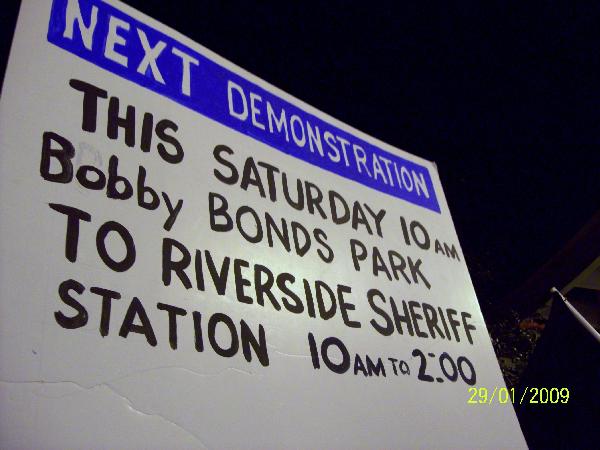
RIVERSIDE, California - January 29, 2009 The Brown Berets of Aztlán led a march from the César Chávez Community Center at the Bobby Bonds Park to the Riverside Sheriff’s Department, where they held a candlelight vigil and demonstration.

They convoked the assembly to build momentum for the movement for justice for Annette García, a Perris resident, Brown Beret member, and mother of six, who was shot in the back on January 23 by a Riverside sheriff’s deputy.

The Brown Berets were joined by mourners, anti-police brutality activists, community members, and immigrant rights activists, many of also protested today’s simultaneous immigration raids in many communities across the Inland Empire.

See also:

cbs2.com - Brown Berets De Aztlan Hold Protest Over Shooting

Brown Berets de Aztlan are recruiting and forming new chapters

Brown Berets de Aztlan protest the police murder of one of their own

ALIPAC - Brown Berets De Aztlan Hold Protest Over Shooting

(Border Patrol agents were reported to have done sweeps in the cities on Rialto and Fontana, as well as paying visits to the Riverside Home Depot and the San Bernardino Greyhound station. See the calendar for information about tomorrow’s emergency press conference.)

But the focus of the evening fell mainly on Annette García, and the need for organization, unity, and action to prevent such acts of state-perpetuated cruelty.

Organizers asked the nearly fifty people present to return on Saturday at 10:00 am for another, larger march and press conference. “Go back, tell people about it. If you’ve got some websites, jump on the websites. On MySpace, send out your bulletins. Tell ‘em how it was today, tell them what you expect to happen Saturday. We wanna raise hell over there at Bobby Bonds Park before we get here. Then we’re gonna close this place down for several hours.”

The impact of the police presence on the local community was underscored by the nearly constant procession of sad-faced family members, some of whom seemed surprised to see protesters upon arriving at the detention center to attempt to free their loved ones.

After several moving speeches and raucous chants, we were all provided rides back to the Chávez center.

“This is not the first time we’ve marched on Riverside,” said one veterano at the initiation of the march.

Nor will it be the last.

2009-01-25

Suit filed in killing by deputy

ADELANTO - The family of a man shot and killed last year by a sheriff’s deputy during a desert struggle filed a $10 million civil lawsuit Friday in U.S. Federal District Court in Riverside.

San Bernardino County sheriff’s Deputy Joseph Janowicz was following up on a theft case Jan. 17 when he drove down Topaz Drive into a rural area. It was there that he found 35-year-old Donald James Hottinger.

Officials say the father of three was “uncooperative,” providing a false name and date of birth. The attorney who filed the lawsuit said Hottinger hadn’t committed a crime and the deputy should not have tried to detain him.

The shooting “was unjustified and they’ve tried to come up with an excuse to explain it,” said attorney Dale K. Galipo. “It adds insult to injury that the Sheriff’s Department tried to fabricate evidence in the way it happened.”

Hottinger grabbed a gasoline can from his truck and doused himself and Janowicz, threatening to light them on fire, officials said.

Then “he grabbed onto the deputy’s arm, got into his car and took off, dragging the deputy with him,” said sheriff’s spokeswoman Cindy Beavers. “At that point, the deputy’s life definitely was in danger.”

Janowicz opened fire, hitting Hottinger. The deputy fell to the ground and the truck continued rolling until it hit a pile of construction debris.

As per procedure, a sheriff’s homicide team investigated the shooting and turned their findings over to the District Attorney’s Office.

Prosecutors have not yet released a report on the incident so the details surrounding the shooting remain unknown.

“We think the evidence will show that he did not run the police officer over nor did he try to set him on fire,” Galipo said.

Hottinger’s family could not be reached for comment Friday. Sheriff’s officials said they cannot comment on lawsuits.

Police “High-Speed Chases:” Another Innocent Life Taken

A 67-year-old San Bernardino woman died early Saturday when a man fleeing police slammed into her car, police said.

Ruby Lene Johnson was driving a 1995 Toyota Camry west on Base Line at about 12:30 a.m. when a speeding 2007 Scion traveling north on Mount Vernon Avenue ran a red light and hit her car, authorities said. She was pronounced dead at the scene, the San Bernardino County coroner’s office said.

Jose Palacios, 20, was arrested on suspicion of vehicular manslaughter, driving under the influence of drugs or alcohol and failing to stop for police. Police said they believe Palacios, whose residence was unknown, was traveling more than 100 mph.

Police were chasing Palacios after another hit-and-run at Foothill Boulevard and Riverside Avenue in Rialto, said police Lt. Gwendolyn Waters.

Victims of that hit-and-run followed Palacios into San Bernardino and flagged down police, who tried to catch up with Palacios near Mount Vernon and Fifth Street, she said. Palacios initially slowed down, then accelerated and attempted to flee, she said.

After the Camry and Scion collided, both vehicles hit two other vehicles in the intersection of Base Line and Mount Vernon before coming to rest about 60 feet north of the intersection, police said. A driver and passenger in one of those other vehicles were injured and taken to Arrowhead Regional Medical Center in Colton.

–David Olson

dolson@PE.com

2009-01-23

Wisconsin takes action to fight domestic abuse among cops

Editor’s note: Recently, a New York City police lieutenant stabbed and shot his wife to death, bringing up the important issue of acknowledging that police officers can be abusers or can be abused by another family member, regardless of age or gender. When Tyler Peterson killed his ex-girlfriend, along with five others, Force Science News consulted 3 prominent authorities on police psychology for their professional insights. Read the article here: Experts look at a young officer’s murderous rampage

MADISON, Wis. — Christmas has twice come and gone since Wayne Coulter last saw Lindsey Stahl alive.

The hurt hangs in his voice as he talks about life without the girl he helped raise since she was a toddler. Words of anger, frustration and sadness come next. They catch in his throat as he tries to rationalize how Lindsey’s life and the lives of five others were taken in Wisconsin’s most extreme, deadly case of officer-involved domestic violence.

Fourteen-year-old Lindsey died on Oct. 7, 2007, in the small, northern Wisconsin town of Crandon. Jarred by the news that his former girlfriend was seeing someone new, 20-year-old Tyler Peterson, an officer employed by the Crandon and Forest County departments, went to the home of his former girlfriend. Upon entering the apartment, he opened fire with an assault rifle on all seven people who were there for a pizza party. A standoff ensued between Peterson and his friends on the force. Peterson eventually killed himself with a pistol.

See related:

Some in Sheriff’s Department are cops gone wild

Ex-SoCal officer pleads guilty in violence case

Ex-deputy admits to sexual misconduct

Former Deputy Gets 16 Months for False Imprisonment (for Sex Crimes) by Fraud or Deceit

Sheriff’s deputy accused of death threats, gun charges returns to work

Riverside County Sheriff’s Deputy Arnulfo Moreno surrenders in attempted murder case

Retired SB Police Det. Blair “Chris” Christopher Hall

Lawsuit expected from woman shot by San Bernardino officer Ryan Thornburg

Riverside County Sheriff’s Deputy Raymond Cesar Vidales suspected of sexually assaulting teen

San Bernardino County sheriff’s deputy Matthew Linderman Sheriff’s Deputy Is A Stalker, Woman Says

Ex-Oklahoma Sheriff Convicted of Rape, Bribery

314 out of 315 ER Doctors Surveyed Agree: Police Brutality is Rampant

Now, the families of three of the six victims and the sole survivor of the shooting have filed a civil suit against the police departments that employed Peterson. The suit charges that the police chief and sheriff knew that Peterson had shown a pattern of domestic violence and abuse of authority but did nothing about it.

Before Forest County denied the initial claim that preceded the lawsuit. County Corporation Counsel Paul Payant told the Associated Press that the Sheriff’s Department had no way of knowing that Peterson was capable of such violence.

Bitter feelings continue to swirl around the community, even toward the families of the victims. Coulter said they have anonymously been receiving “nasty letters saying we should drop the suit, and we should be hanging our heads in shame.

“It’s pretty rough living up here now.”

News of the crime in Crandon rang out far beyond the small town’s borders; even the Los Angeles Times reported on the story. The crime not only received national exposure, but put faces to a grim reality of the law enforcement community, a reality seldom discussed outside internal affairs offices or among officers themselves.

Yet those in the know — the officers, prosecutors and domestic violence advocates — have become increasingly aware of the higher prevalence of domestic violence in the families of law enforcement officers.

The National Center for Women and Policing cites two studies from the mid-1990s that have found at least 40 percent of police officer families experience domestic violence, defined as verbal, psychological or physical abuse, in contrast to 10-20 percent of families in the general population. The studies are well-regarded and often cited by law enforcement and domestic violence advocates locally and nationally.

In the Madison area, Dane County Sheriff Dave Mahoney said two officers had been disciplined internally for domestic violence incidents in the past year, but no criminal charges were brought against them. They are still on the force. Following an open records request, the Madison Police Department reported that one officer has been fired or suspended for domestic violence in the past five years. That was Russell Henderson, who was fired in 2006.

In Wisconsin, nobody is keeping track of the problem. Unless an officer shoots or severely abuses someone, news about an incident will rarely make its way out of internal affairs, and no state agency collects the data.

But state law enforcement officials are concerned about the problem, and this summer, the Law Enforcement Standards Board approved a new policy and 99-page training manual. All new law enforcement recruits will now learn about how officer-involved domestic violence cases should be handled from the moment a call is received, on through how an allegation is vetted and potentially prosecuted in court. Current officers don’t have to take the training, but they can do so by attending a training seminar, one of which was held Tuesday in Green Bay. Another is being held in Oconomowoc on Thursday.

“This is no longer law enforcement’s dirty little secret,” said Michael Serpe, a board member of the Law Enforcement Standards Board since 2003 and the Door County administrator. “The research has been out there for years. Police officers are more inclined than other groups to be involved with domestic violence themselves. It is time to raise the public’s awareness on this issue.”

Reasons for the prevalence of domestic abuse among officers are numerous. Historically, police were reluctant to pursue domestic violence cases, seeing them more as lovers’ quarrels meant for social workers to handle rather than police officers. While this viewpoint has evolved over the years with the criminalization of domestic violence crimes, some officers remain reluctant to crack down on their own. Even the state’s own training manual reads: “Officers’ reluctance to consider officer-involved domestic violence as a crime remains the final obstacle to overcome.”

The reluctance may be a consequence of one of the central tenets of police culture.

“The first rule is a code of silence,” said Diane Wetendorf, an independent consultant on officer-involved domestic violence based in Arlington Heights, Ill. “They don’t rat on each other.”

There is a logical reason for the protective atmosphere. The culture not only builds trust and security among those in a department, but is necessary in a profession that can be extremely stressful and dangerous.

“Not all police officers are abusers. Nobody ever said they were,” said Dottie Davis, a deputy chief of the Fort Wayne, Ind., Police Department and keynote speaker at this week’s training sessions in Wisconsin. “But for those who are, we have to police our own and hold officers to the same standards as the average citizens.”

For those who do turn abusive, combat skills taught at the police academy can be used to grim effect at home.

Prosecutors say former Wausau police officer Chueng Lee used intimidation tactics and expertise he gained from investigating accidents in an attempt to kill his wife in a car crash on Sept. 18, 2007.

On that night, Lee, 47, dropped the speed of his truck down from the posted 55 mph limit to between 25 and 30 mph on a rural country road, Shawano County District Attorney Gregory Parker said in an interview. Lee then turned the car into one of only two concrete bridge abutments in Shawano County. Parker described the concentrated impact to the passenger-side headrest, where Lee’s wife was sitting, as “astounding.”

“He was a cop. He knew what he was doing and he knew how to drive that vehicle,” Parker said. “There were a lot of us — investigators and such — that thought that’s what was going on in relation to how he crashed the vehicle.”

Parker said he had officers within Lee’s jurisdiction set to testify at the jury trial. Had those officers had a chance to take the stand, they would have told of another incident in which Lee followed his wife and repeatedly nudged her car with his vehicle, Parker said.

“Officers had contacted him and told him he needed to cease this type of behavior or he would be charged,” Parker said. Several days later, Lee drove into the bridge.

Before those officers had a chance to testify, Lee accepted a plea deal. When he did, his wife recanted her story. She told the judge she still loved her husband and still wanted to be with him. She said she was joking when officers interviewed her about the incident and told the judge that Lee wasn’t trying to kill her, Parker said.

Despite that, Lee was sentenced to three years in prison followed by two years of extended supervision.

Having a victim recant is always a concern for prosecutors in domestic violence cases, but particularly so in cases involving police officers. A domestic violence conviction is a career killer for them. A misdemeanor or felony conviction means the officer can no longer use or own a firearm. No gun, no job. If money and financial security are issues for the abused, this reality may push a victim toward recanting their story.

“It is great to have a policy, but if the victim will suffer a financial toll, too often the victim is silenced,” said Margie Moore, director of the National Center for Women and Policing. “We really need to look at financial solutions for those who come forward.”

Wetendorf, who has worked with domestic violence victims for nearly 30 years, said the knowledge police officers have of how victims typically seek help also makes coming forward more difficult for victims. The advice she usually gives to victims — call the police, seek assistance at a shelter — doesn’t work. Officers know the locations of domestic abuse shelters. They know if a call is placed to police. If the officer works undercover, they are trained to deceive people, which helps them hide their abuse from others. Then there’s the credibility issue. Wetendorf said officers commonly warn their victims that it will be their word against the word of an officer.

“Domestic abuse is about power and control,” Wetendorf said. “And policing is about gaining and maintaining power and control. The skills that can make a competent police officer can make a dangerous abuser.”

In the early 1980s, Deputy Chief Davis of the Fort Wayne Police Department was in an abusive relationship with her husband. He was also a police officer. The two worked in different departments, which Davis never names in her frequent public lectures on officer-involved domestic violence.

In her case, the verbal and psychological abuse started when he began to tell her she was “wasting a man’s job.”

Tactics he had learned at the academy came next. He would sweep his leg under her to knock her to the floor and then pin her down. The move is used to bring someone under control quickly in the field and to leave no visible signs of injury. The tactics had the same effect on her.

But a female sergeant who worked with Davis recognized signs of domestic abuse. When confronted, Davis denied it. The female officer ordered her into counseling. Meanwhile, her husband was promoted. She stayed with her husband until the abuse turned toward their young daughter. Then she left him.

Because Davis called 911 on several occasions, she knew others were aware of the abuse. She never pressed charges and her ex-husband was never reprimanded or criminally charged. Davis said the police never wrote reports and that the dispatch reports, which at the time were paper cards, were destroyed by fellow officers.

“In other words, it never happened,” Davis said.

She feels safe to talk about her experience now because most of the officers connected to her ex-husband are either dead or retired.

While the incidents occurred some 25 years ago and awareness about domestic violence is greater, a perception in the community persists that law enforcement officers are not held to the same standards as private citizens when it comes to domestic violence. Even Wisconsin’s new training manual on officer-involved domestic violence references the belief, and some recent examples give it credence.

On Dec. 15, 2005, David Riedel, a former Sauk County deputy, attended a party with his girlfriend and other law enforcement officers in Wisconsin Dells. The night turned violent after Riedel’s girlfriend, former Stoughton police officer Sonya Flower, talked with other officers, court records say. After fighting in a hotel room, Riedel tried to leave. To prevent him from driving drunk, Flower laid down behind his truck and he drove over her.

He then shouted: “You crazy f—— b—-, move,” Flower told investigators.

Flower passed out for awhile. She then dragged herself to a nearby hotel where she received help. Her liver was cut and her ribs and arm were bruised.

The next morning, Riedel admitted to officers he had been drinking. According to court documents, he said he didn’t remember running over Flower.

At one point, Riedel faced a felony hit-and-run charge. These days, his record is clean, thanks to Columbia County District Attorney Jane Kohlwey and Riedel’s attorney, Bruce Rosen of Madison.

Rather than potentially stand trial on the charges, Riedel was offered a deferred prosecution agreement. Under Wisconsin law, a deferred prosecution agreement allows a person facing criminal charges to fulfill certain conditions in return for a dismissal of the charges against them. To be eligible, the offender, in this case Riedel, usually does not have a criminal record, must be willing to participate in the agreement and accepts responsibility for the crime.

An investigation by the Baraboo News Republic, a sister publication to The Capital Times, revealed that Kohlwey pledged to destroy documents that detailed what Riedel would do to get the charges against him dismissed. Meanwhile, Flower was kept in the dark.

Last August, the manner in which this case was handled caused the Crime Victims Rights Board, an independent agency with staff support from the Wisconsin Department of Justice, to reprimand Kohlwey for her handling of the case.

With no felony conviction, Riedel could continue to own and operate a gun. The deal saved his career.

In an interview with the News Republic in December, Kohlwey said saving Riedel’s career was not her intent and that entering into the “secret agreement” to keep the conditions of the deferred prosecution agreement confidential was a “serious judgment error.”

While the charges against Riedel still were pending, Hillsboro Police Chief Thomas Richardson needed to fill a part-time spot on his small staff, a staff that included himself, another full-time officer and two part-time officers. Richardson said when he called Riedel’s attorney and authorities in Sauk County, he was told the charges against Riedel were going to be dismissed. With no conviction pending, Richardson said he felt comfortable hiring Riedel as his third part-time officer.

“He is a very good officer, and therefore he is still working here,” Richardson said. “From what I understand, he got messed up with the wrong girl.”

Like Riedel, Henderson — the Madison officer who was fired — also received a deferred prosecution deal. He pleaded guilty to disorderly conduct and making a telephone threat connected to an incident with his stepson and was terminated from the department in 2006, but the charges against him were dismissed after he completed the terms of a deferred prosecution agreement.

Henderson’s domestic violence issues came to light after he allegedly put his wife’s 15-year-old son in a headlock and slammed him into a door in 2004. His wife told officers investigating the incident with her son that she had twice called police to report domestic violence incidents, but when they arrived, she told them that nothing happened because she feared Henderson would lose his job. One incident allegedly occurred Nov. 3, 2003, when Henderson grabbed his wife by the hair and pulled her across the floor. She fell to the floor, then called police. The second incident occurred in May 2002 when Henderson allegedly shoved her to the ground with enough force to bruise her chest.

In Wisconsin Dells, the fallout from Riedel’s night out in Wisconsin Dells a little over three years ago continues.

On Dec. 11, 2008, Flower filed a civil suit in Sauk County against Riedel and several insurance companies. The lawsuit says Riedel caused pain and suffering as well as physical injury to Flower and should have to pay her medical expenses and lost wages.

With the civil suit now pending against Riedel and another one pending in Crandon, some departments are finding it may not be financially worth their while to keep quiet when it comes to officer-involved domestic violence.

The city of Tacoma, Wash., learned this lesson to the tune of a $75 million wrongful death suit when the city’s police chief shot himself and his wife on April 26, 2003. David Brame died instantly. His wife, Crystal Judson Brame, died a week later. The extremely public murder-suicide occurred a day after Tacoma city officials publicly stated they would not investigate Crystal’s claims of domestic abuse. On behalf of the couple’s two young children, Lane Judson, Crystal’s father, filed the suit.

Lane Judson said the secrecy had gone on long enough.

“It was never about the money,” Judson said. “It was meant to get their attention, and it did.”

The suit was settled for $12 million. In addition, the municipalities paid for the construction of the Crystal Judson Family Justice Center.

Lane Judson also pushed for the passage of a law in Washington that requires each police department to have an officer-involved domestic violence policy in place. Washington is the first and only state to have a mandated policy.

Wisconsin’s new policy differs in that departments do not have to adopt it. The number of police departments in Wisconsin that choose to adopt the policy remains to be seen.

On the national level, the Crystal Judson Brame Domestic Violence Protocol Program, an amendment to the federal Violence Against Women Act, provides access to upward of $180 million annually to law enforcement agencies to use in training their officers in the area of domestic violence. After reading Wisconsin’s policy, Lane Judson said Wisconsin was on the right track.

“They are making a heck of a good attempt to get something accomplished,” Judson said. “You can always improve on what you do.”

While some find fault with the policy, saying it doesn’t go far enough to protect the victims and has only been introduced for liability reasons, others see it as a first step toward increasing awareness on the issue.

“Is it the cure-all? No,” said Patti Seger, executive director of the Wisconsin Coalition Against Domestic Violence and a member of the Law Enforcement Standards Board. “But instead of sitting and watching these tragedies happen over and over again, we took action.”

Recent examples of officer-involved domestic violence in Wisconsin

Ten days before Christmas, Thomas Hutchins, an off-duty Milwaukee County sheriff’s deputy, became upset when his girlfriend started disciplining their child. After striking his girlfriend in the face, Hutchins was asked to leave. When he refused, she started to call 911. Hutchins pulled the phone out of the wall, then pointed his handgun at her saying, “You take my job, I’ll take your life,” according to the criminal complaint.

Two shots were fired before his girlfriend ran to a nearby apartment. Hutchins then fired through the door. A 12-year-old girl was shot three times. Hutchins is now charged with first-degree intentional homicide, first-degree reckless injury and reckless use of a firearm. He has resigned from his job.

Robert E. Hietala, 36, a former Sheboygan Falls police sergeant, was off duty on Oct. 2, 2005, when a fight broke out between him and his wife.

Police were called to Hietala’s home after his son called 911 and told a dispatcher that Hietala was threatening his mother with a gun. The argument was about the working hours of Hietala’s wife. Hietala told his wife to leave the home, which she refused to do, police said. The former police sergeant told his wife if she didn’t leave “he would have no choice but to hit her and throw his cell phone at her,” the criminal complaint said.

Hietala resigned from the police department several days after he was charged on Oct. 3 with misdemeanor disorderly conduct/domestic abuse while armed. Hietala’s resignation came in the midst of an internal investigation. He was later found guilty of the crime.

In May 2005, Beloit police officer Sheldon Kroning, 27, was arrested and given a one-day suspension following an incident of domestic-related disorderly conduct.

The verbal fight occurred between Kroning and a live-in girlfriend.

According to court records, Kroning participated in a deferred prosecution agreement and charges against him were dismissed.

Galesville police officer James T. Brudos, 39, was put on administrative leave after he was found trespassing on a former girlfriend’s home in Jackson County. He was found guilty of disorderly conduct on April 16, 2004. Through a plea deal, the Jackson County District Attorney’s Office agreed to dismiss the domestic violence enhancer to the disorderly conduct and bail-jumping charges if Brudos stayed out of trouble for nine months and agreed to meet other conditions. Within a month, Brudos was reinstated to his job in law enforcement.

Creating Prisoners is a Booming Industry in Need of a Bust

In 2008, the United States passed a benchmark previously unheard of. For the first time in the nation’s history, every one in 100 adults was behind bars, making it no question that the USA is number one in the world when it comes to making people prisoners.

Since 1980, the overall prison population has seen a 400 percent surge.

For almost 30 years the people of this nation have watched blindly as state and federal legislatures composed hyperbolic crime-fighting schemes with euphemistic titles like: “tough on crime,” “truth in sentencing,” “three strikes,” or “The War on Drugs.”

We ate up the façade of security while they scaled back the evolution of the American justice system.

There exists, in this country, a prison industrial-complex.

An organized and systematic network of interest groups, lawyers, politicians, prison guard unions and construction companies, who form the cyclic mechanisms which hold the socially destructive machine in place.

They are the profiteers of imprisonment, bound not by the desire to correct or rehabilitate, but by the scent of big business.

See also:

Excellent Article on the Corrupt Prison-Industrial Complex

The Militarization of our Local Police

How you became the enemy

Prisoners In 2007: 1 in 31 American Adults Now in Prison, Jail or on Parole

Democracy’s Ghosts: How 5.3 Million Americans Have Lost The Right To Vote

November Coalition

We sat around and watched as they built them up, one by one. Big concrete blocks built to hold as many human bodies as they could.

In some cases private companies built their for-profit prisons before they had even received a contract from the government.

In one such case in 1997, a company called Corrections Corporation of America (a major contributor to the American Legislative Exchange Council) built a 2,000-bed facility in California at a cost of $80-$100 million with no contract from the California Department of Corrections.

“If we build it, they will come,” said one of the company officials.

They did come, and that is the problem.

The prison industry has seen a massive boom in last few decades, and when the industry that symbolizes crime-fighting sees a boom, we are led to believe that it is crime that suffers.

Politicians gawk at the chance to rubber stamp their name on anything that will equate to positive crime-fighting statistics.

Yet, is it logical to believe that the true path to achieving a society less rampant with crime is to lock up one of every 100 citizens?

The state of California has been a prison playground for this past boom in corrections.

However, with the economy $41 billion in the hole, and prison overcrowding increasing faster than they can build prisons, it is incredibly imperative that action be made to twinge the machine rightward.

Gov. Arnold Schwarzenegger wants to eliminate parole for all offenders not convicted of violent or sex-related crimes, reducing the parole population by about 70,000.

He also wants to divert more petty criminals to county jails and grant early release to more inmates - steps that could trim the prison population by 15,000 over the next 18 months.

These actions may very well represent the light at the end of a tunnel, an indirect chance for Legislature to stop concurring with those out to make money in the “prison business” and a chance to bring the cogs of the complex to a complete stop.

If Schwarzenegger makes these changes then there is hope.

Our fiscal troubles as a state put us in a position to stand up to those lobbying for the imprisonment of more and more Americans in order to tell them that the expense will no longer be paid.

One of 100 is a number that will not be accepted, no one has that many criminals.

2009-01-22

Someone else is spying on YOU. And it isn’t the NSA. Fusion Centers.

JaciCee
Daily Kos
January 22, 2009

Ever hear of a Fusion Center?

They are run by the Department of Homeland Security and are locally based across the country.

A fusion center is an effective and efficient mechanism to exchange information and intelligence, maximize resources, streamline operations, and improve the ability to fight crime and terrorism by merging data from a variety of sources.

At first blush this sounds good. After 9/11 discussions were had about how to streamline communication between local and federal law enforcement agencies.

From the Department of Homeland Security website:

Many states and larger cities have created state and local fusion centers to share information and intelligence within their jurisdictions as well as with the federal government. The Department, through the Office of Intelligence and Analysis, provides personnel with operational and intelligence skills to the fusion centers. This support is tailored to the unique needs of the locality and serves to:

help the classified and unclassified information flow,
provide expertise,
coordinate with local law enforcement and other agencies, and
provide local awareness and access.

But, it is being alleged that something has gone wrong along the way. Fusion centers have now come under the scrutinizing eye of the ACLU, and for good reasons.

Who is spying in your neighborhood?

These centers have been placed in our neighborhoods. Our local fusion center is located on Bataan Boulevard in Santa Fe, New Mexico. You can find the fusion center nearest you by clicking on this interactive map. The ACLU has also set up a site that tracks camera surveillance. Video surveillance is nothing new, but:

Video surveillance is not a new phenomenon, but the amount of attention that the federal government has been paying is. In the past five years, the Department of Homeland Security has awarded $300 million in grants to state and local governments, all in the name of public video surveillance.

From the same article:

Meanwhile, a timely University of California study has found that San Francisco’s $700,000 ‘Crime Camera’ program has had no impact on violent crime since its 2005 installation. The study also states that robberies dropped significantly within each camera’s radius, but notes that this finding is inconclusive.

These two paragraphs beg some further discussion. Is the surveillance arm of the Department of Homeland Security working in conjunction with the fusion center in this California neighborhood? If surveillance cameras aren’t reducing crime significantly, what other purposes are they serving?

From California again:

The Electronic Frontier Foundation and the ACLU of California have filed a federal lawsuit against the FBI and local authorities over the seizure and search of two organizations’ computers, they jointly announced Wednesday.

On August 27, 2008, the University of California Police, the Alameda County Sheriff’s Department and the FBI took part in a raid of the Berkeley offices of two politically active groups, Long Haul Infoshop and East Bay Prisoner Support Group (EBPS), seizing every computer in the building, even those behind locked doors, which were opened by force. The raid was conducted despite no allegations of wrongdoing on the part of either organization or any of their members, and the complaint questions the legality of the warrant obtained by authorities.

Why search and seize at the Long Haul Infoshop or the East Bay Prisoner Support Group? Was the FBI working in conjunction with the local fusion center? More questions.

The neighborhood spying isn’t limited to California.

From the Washington Post:

Organizational meetings, public forums, prison vigils, rallies outside the State House in Annapolis and e-mail group lists were infiltrated by police posing as peace activists and death penalty opponents, the records show. The surveillance continued even though the logs contained no reports of illegal activity and consistently indicated that the activists were not planning violent protests.

The records show that undercover agents collectively spent 288 hours on surveillance activities over 14 months from March 2005 until May 2006.

The fusion center in New Mexico is known as a "cut and paste" shop. Analysts peruse media, in all forms (print and electronic), clipping information that they feel is "important" or "questionable." It is also alleged that they peruse the internet. It wouldn’t surprise me if they were reading this diary, now.

Their peering eyes are looking into the private sector:

A new institution is emerging in American life: Fusion Centers. These state, local and regional institutions were originally created to improve the sharing of anti-terrorism intelligence among different state, local and federal law enforcement agencies. Though they developed independently and remain quite different from one another, for many the scope of their mission has quickly expanded - with the support and encouragement of the federal government - to cover "all crimes and all hazards." The types of information they seek for analysis has also broadened over time to include not just criminal intelligence, but public and private sector data, and participation in these centers has grown to include not just law enforcement, but other government entities, the military and even select members of the private sector.

Legislation has been drafted, and will be presented to the New Mexico State Legislature, addressing concerns over the fusion center in Santa Fe.

A draft of the ACLU legislation, sponsored by Rep. Antonio "Mo" Maestas, D-Albuquerque, would prohibit a law enforcement agency from collecting, maintaining and sharing "with any other law enforcement agency, information about the political, religious or social associations, views or activities of a person unless" they are suspected of committing a crime.

That is the kicker…they aren’t watching American citizens who are suspected of committing crimes. They are watching whoever they want to.

A quick summary:

But in a democracy, the collection and sharing of intelligence information - especially information about American citizens and other residents - need to be carried out with the utmost care. That is because more and more, the amount of information available on each one of us is enough to assemble a very detailed portrait of our lives. And because security agencies are moving toward using such portraits to profile how "suspicious" we look.

American citizens aren’t being spied on just by the NSA. They are being spied on by the fusion center office around the corner.

Pinal County, AZ, shelves speed-camera program

Pinal County supervisors Wednesday bid goodbye to photo enforcement.

Their vote to terminate their contract with Redflex, the company that operates the cameras, came at the recommendation of the county's top law-enforcement official, new Pinal County Sheriff Paul Babeu.

"I'm against photo speed enforcement completely," Babeu said, walking the three-member panel through a detailed PowerPoint presentation. "Here in Pinal, it's failed miserably."

Babeu said speed cameras created dangerous road conditions and offered little financial benefit for the county. He plans to boost traffic enforcement through additional manpower.

Although Pinal County's contract with Redflex wasn't set to expire until Feb. 20, two mobile speed cameras have not been in operation on Pinal roads since Babeu took office Jan. 1.

The speed vans had been roadside in some of Pinal's most populous areas, including Apache Junction, Gold Canyon and unincorporated areas near Queen Creek, since mid-2007.

The county's program is separate from the one operated by the Arizona Department of Public Safety on freeways statewide.

The supervisors two weeks ago had tabled a vote on the Redflex contract because they wanted Babeu to prepare a report on camera enforcement in Pinal, including the financial impact on the county.

He reported Wednesday that the two cameras were activated 11,416 times from September 2007 through last month. Of those activations, 7,290 resulted in citations, but only 3,711 were paid.

Babeu said most of the total $134,199.43 in fines and fees from the paid citations covered administrative and operational costs, leaving the county with a net profit of $12,391.58 that Babeu dismissed as paltry.

Moreover, Babeu said, total motor-vehicle accidents increased by 16 percent in the same time period, and fatal collisions in the Queen Creek area doubled from three to six.

The sheriff said he couldn't be certain that speed cameras were to blame for the crashes, but he believes they were a factor.

Collisions were said to be the reason Redflex was implemented on county roads. Former Sheriff Chris Vasquez initiated the contract to minimize an increasing number of crashes on Hunt Highway, the main thoroughfare connecting north-central Pinal County with Maricopa County.

Babeu thinks that putting more deputies on patrol offers the best way to improve safety, instead of relying on cameras that "can't catch drunk drivers" or stop motorists involved in illegal or dangerous activities.

The sheriff has increased his traffic-enforcement unit from two to four deputies, and a fifth will join the team soon. Babeu said the changes were made at no county cost as part of a departmentwide reorganization.

Babeu estimated that the volume of citations issued annually by the Sheriff's Office would increase sharply as a result of having more deputies on the streets. He said the five-member team alone could generate 10,400 to 20,800 citations a year.

Supervisor Bryan Martyn, whose district was the primary operating area for the speed vans, said he received a number of letters from residents who favored speed-camera enforcement, but he "doesn't presume to tell the sheriff how to do his job."

"He believes he has a better solution to this public-safety concern," Martyn said. "What he's proposing is prudent and seems to make sense. If it goes as sold, you may be praying for photo radar again."

Babeu may answer those prayers in a different way. He wants to bring red-light cameras to the county.

Speedball Beer Facing Sales Ban

speedball-beer.jpg

HEY! I wanted drugs, not beer…

A beer called Speedball has been criticised amid claims it promotes the drugs mix that killed actors John Belushi and River Phoenix. Speedballing is the name given to combining heroin and cocaine.

A complaint has been upheld against Fraserburgh’s BrewDog under the drinks industry watchdog the Portman Group’s code of practice.

However, a BrewDog spokesman said Speedball was “for those who enjoy a quality beer responsibly”.

David Poley, Portman Group chief executive, said the marketing was grossly irresponsible.

He said: “The blurring of alcohol and illicit drugs fosters unhealthy attitudes to drinking and trivialises drug misuse.

“BrewDog is profiteering from the scourge of illegal drugs, mocking the misery caused by misuse

But is the beer any good?

Breathalyzer Source Code Required for Use as Evidence

Posted on: January 21, 2009 9:30 AM, by Ed Brayton

Here's a very interesting case from Florida, where an appeals court has upheld a lower court ruling that threw out evidence from a breathalyzer test in a drunk driving case because the manufacturer of the device refused to release the source code and allow defense experts to analyze the accuracy of the machines.

The results of breath tests in more than 100 local drunken-driving cases will not be allowed at trial, a judge announced Tuesday.

The validity of those breathalyzer tests has been challenged for more than three years because of the Intoxilyzer 5000, a machine that uses a breath sample to measure a person's blood-alcohol content.

Manatee County Judge Doug Henderson ruled two years ago that any Intoxilyzer 5000 tests were inadmissible in trial, but prosecutors appealed. On Tuesday, Henderson told lawyers that his ruling had been affirmed by the Second District Court of Appeal and Circuit Court.

Breath analysis machines are notoriously inaccurate and this has been a problem for a very long time. Dr. David Hanson, a sociologist who has written on this issue for decades, writes:

Breath analyzers (Breathalyzer, Intoxilyzer, Alcosensor, Alcoscan and BAC Datamaster are common brand names) don't actually test blood alcohol concentration (BAC), which requires the analysis of a blood sample. Instead, they estimate BAC indirectly. Different types of machine use different techniqes and larger machines generally yield better estimates than do hand-held models. Therefore, some states don't permit data or "readings" from hand-held machines to be presented as evidence in court. South Dakota does not even permit evidence from any type or size breath tester but relies entirely on blood tests to ensure accuracy and protect the innocent.

A major problem with some machines is that they not only identify the ethyl alcohol (or ethanol) found in alcohol beverages, but also other substances similar in molecular structure. Those machines identify any compound containing the methyl group structure. Over one hundred compounds can be found in the human breath at any one time and 70 to 80 percent of them contain methyl group structure and will be incorrectly detected as ethyl alcohol. Important is the fact that the more different ethyl group substances the machine detects, the higher will be the false BAC estimate.

The National Highway Traffic Safety Administration (NHTSA) has found that dieters and diabetics can have acetone levels hundreds and even thousand of times higher than that in others. Acetone is one of the many substances that can be falsely identified as ethyl alcohol by some breath machines.

One investigator has reported that alcohol-free subjects can generate BAC readings of about .05 after eating various types of bread products.

Substances in the environment can also lead to false BAC readings. For example, an alcohol-free subject was asked to apply a pint of contact cement to a piece of plywood and then to apply a gallon of oil-base paint to a wall. The total activity lasted about an hour. Twenty minutes later the subject was tested on an Intoxilyzer, which registered a BAC of .12 percent. This level is 50% higher than a BAC of .08, which constitutes legal intoxication in many states.

Similarly, a painter with a protective mask spray painted a room for 20 minutes. Although a blood test showed no alcohol, an Intoxilyzer falsely reported his BAC as .075.

Any number of other products found in the environment can cause erroneous BAC results. These include compounds found in lacquers, paint removers, celluloid, gasoline, and cleaning fluids.

Other common things that can cause false BAC levels are alcohol, blood or vomit in the subject's mouth, electrical interference from cell phones and police radios, tobacco smoke, dirt, and moisture.

Breath testers can be very sensitive to temperature and will give false reasings if not adjusted or recalibrated to account for ambient or surrounding air temperatures. The temperature of the subject is also very important. Each one degree of body temperature above normal will cause a substantial elevation (about 8%) in apparent BAC.

Many breath testing machines asume a 2,100-to-1 ratio in converting alcohol in the breath to estimates of alcohol in the blood. However, this ratio varies from 1,900 to 2,400 among people and also within a person over time. This variation will lead to false BAC readings.

Physical activity and hyperventilation can lower apparent BAC levels. One study found that the BAC readings of subjects decreased 11 to 14% after running up one flight of stairs and 22-25% after doing so twice. Another study found a 15% decrease in BAC readings after vigorous exercise or hyperventilaion.

Some breath analysis machinnes assume a hematocrit (cell volume of blood) of 47%. However, hematocrit values range from 42 to 52% in men and from 37 to 47% in women. A person with a lower hematocrit will have a falsely high BAC reading.

It's about time a judge took a stand on this issue.

Ex-NSA analyst: Agency spied on news organizations

A former National Security Agency analyst told MSNBC’s Keith Olbermann Wednesday night that the Bush Administration targeted and eavesdropped on the conversations of American journalists.

Share:
· Facebook
· LinkedIn
· Email
· Print
· Link

Russell Tice, one of the sources who revealed the secret NSA warrantless wiretapping program to The New York Times in 2005, gave harrowing details about the NSA’s wiretapping program in an interview less than 24 hours after President George Bush left office.

He told Olbermann that the NSA collected all communications from various U.S. groups, many of which had nothing to do with terrorism:

Tice: Now, what I was finding out, though, is that the collection on those organizations was 24/7, and you know, 365 days a year, and it made no sense. And that's -- I started to investigate that. That's about the time when they came after me, to fire me. But an organization that was collected on were U.S. news organizations and reporters and journalists.

Olbermann: To what purpose? I mean, is there a file somewhere full of every e-mail sent by all the reporters at the "New York Times?" Is there a recording somewhere of every conversation I had with my little nephew in upstate New York? Is it like that?

Tice: If it was involved in this specific avenue of collection, it would be everything. Yes. It would be everything.

When Bush defended the secret wiretapping program after it became public a little more than three years ago, he said that only international communications were monitored as a way to collect terrorism intelligence. But Tice said that was not true.

“The National Security Agency had access to all Americans' communications, faxes, phone calls, and their computer communications. And that doesn't -- it didn't matter whether you were in Kansas, you know, in the middle of the country, and you never made a communication -- foreign communications at all. They monitored all communications,” he said.

Additionally Tice told Olbermann that "the agency would tailor some of their briefings to try to be deceptive” to congressional committees so that no one would know exactly what the NSA was collecting.

Olbermann asked Tice if President Barack Obama could, and would, stop the NSA from continuing to spy on Americans. Tice responded that he had tried to reach out to the Obama Administration and was still hoping he could work with the White House on intelligence issues.

The American Civil Liberties Union is challenging the NSA wiretapping program, as legalized by the FISA Amendments Act of 2008, in federal court in Manhattan. The Reporters Committee filed a friend-of-the-court brief in the case, Amnesty International v. McConnell, arguing that the law violates the First Amendment rights of journalist to conduct interviews with their sources.

Samantha Fredrickson, 3:48 pm · Comments: 0

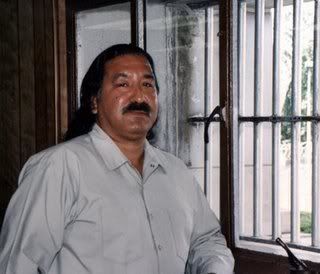
Leonard Peltier beaten in prison

By Brenda Norrell

Photo LPDOC

CANAAN, Penn. -- Leonard Peltier was jumped and beaten after being transferred from a prison in Lewisburg to Canaan on January 13. The family, however, was not notified by the prison and received the information by way of a letter from Peltier. Peltier, 64, was placed in solitary confinement and it is not known if he has received medical attention.

"Once Mr. Peltier arrived at the Canaan prison facility, he was jumped by younger inmates, severely beaten, put in solitary confinement and placed upon meal restrictions despite his having diabetes and other medical conditions," the Leonard Peltier Defense Offense Committee said in a statement ."The family has requested copies of the video tapes of that incident to no avail. It is as if the whole scenario was contrived to detract from the fact that Mr. Peltier has been a model prisoner having more than enough points to qualify for parole," LPDOC said.

Recently, the amount of hate mail circulated on the Internet regarding Peltier and appeals for his release has increased and could have played a role in the attack on Peltier.

The LPDOC said, "Retired, former and actively employed FBI agents have taken action against the release and parole of Leonard Peltier time and again. While it is their right to speak their opinion, it is not right to do so on federal time and at the taxpayer’s expense. Their letters, writings, articles, books, protests, outcries and interviews concerning Mr. Peltier, are a conflict of interest and tip the scales against him unfairly. In addition, it is certainly questionable as to the timing of a letter written by a former FBI Agent to Representative John Conyers and the beating Mr. Peltier received at Canaan."

The LPDOC said the attack on Peltier comes on the heels of the FBI's recent letter, prompting this attack by FBI supporters as an attempt to discredit Peltier as a model prisoner. "Anyone who has been in the prison system knows well that if you refuse to name your attackers or file charges against them, then you lose your status as a victim and/or given points against your possible parole and labeled as a perpetrator. It is not uncommon, in fact is quite common for the government to use Indian against Indian and they still operate under the old adage "it takes an Indian to catch an Indian," LPDOC said.

In 1978, the US government made an attempt to assassinate Peltier, offering another Indian inmate at Marion prison with Leonard Peltier, a chance at freedom. The man was Standing Deer. Standing Deer befriended Peltier in prison and exposed the plot to assassinate him. Standing Deer was murdered in Houston after his release from prison.

LPDOC said, "Standing Deer chose to reveal the plot to him instead of taking his life in exchange for a chance at freedom. When Standing Deer was released in 2001, he joined the former Leonard Peltier Defense Committee as a board member. He also began to speak on Leonard's behalf until his murder six years ago today. Prior to his murder, Standing Deer confided with close friends and associates that the same man who visited him in Marion to assassinate Peltier, had came to Houston and told him that he had better stay away from Peltier and anything to do with him," the LDPOC said. (An interview with Ben Carnes on Standing Deer and Peltier can be heard at Censored News Blog Radio or at Earthcycles on Longest Walk.)

Micheal Kuzma, an attorney for Leonard Peltier's defense, described the attack on Peltier in prison, during an interview with American Indian Airwaves on Wednesday, Jan. 21. Kuzma said Peltier's sister Betty Peltier-Solano, executive coordinator of the Leonard Peltier Defense Offense Committee,
received a letter from Peltier, but was never notified by prison officials of the attack. Peltier was transferred from Lewisburg to Canaan prison during the week of Jan. 12th and attacked on the 13th, by other inmates.

Kuzma said, "According to the letter, he thinks he might have a concussion. His middle finger on his left hand is either broken or badly injured. He has a large bump near his right wrist. The right side of his rib cage and chest are in pain. He also has a bruise on the right side of his chest. He also has a bruise on his left knee, and is suffering from headaches. These headaches are a direct result of the Jan. 13 beating."
Listen (last 20 minutes of program) on Jan. 21 at:
http://archive.kpfk.org/parchive/xml/americanindian.xml

AIM West plans a protest in solidarity with Peltier to draw attention to the attack and call for his release on Friday in San Francisco. http://www.aimwest.info/

For more information: LPDOC: http://www.whoisleonardpeltier.info/

Updates at Censored News: http://www.bsnorrell.blogspot.com

Mexican Drug War Violence Is Going off the Charts

President-elect Barack Obama met Monday with Mexican President Felipe Calderón to discuss bilateral issues of major importance for the two countries. In addition to NAFTA and immigration policy, Mexico's ongoing plague of prohibition-related violence was high on the agenda.

More than 5,400 people were killed in the violence last year, and more than 8,000 in the two years since Calderón ratcheted up Mexico's drug war by sending thousands of troops into the fray. The multi-sided conflict pits rival trafficking groups -- the so-called cartels -- against each and the Mexican state, but has also seen pitched battles between rival law enforcement units where one group or the other is in the pay of the traffickers.

The Obama-Calderón meeting comes as the violence in Mexico is creating increasing concern among US policy and defense analysts. Last month, the National Drug Intelligence Center warned in its National Drug Threat Assessment 2009 that "Mexico drug trafficking organizations represent the greatest organized crime threat to the United States."

In a December report to the US Military Academy at West Point, former drug czar retired Gen. Barry McCaffrey warned dramatically that even the $1.4 billion, three-year anti-drug assistance plan approved by Congress and the Bush administration last year was barely a drop in the bucket, noting that it was only a tiny fraction of the money spent on the US wars in Iraq and Afghanistan.

"The stakes in Mexico are enormous," McCaffrey warned. "We cannot afford to have a narco state as a neighbor. Mexico is not confronting dangerous criminality -- it is fighting for its survival against narco-terrorism."

The consequences of US failure to act decisively in support of Calderón's drug war would be dire, McCaffrey warned. "A failure by the Mexican political system to curtail lawlessness and violence could result in a surge of millions of refugees crossing the US border to escape the domestic misery of violence ... and the mindless cruelty and injustice of a criminal state."

This week, the US Joint Chiefs of Staff jumped on the bandwagon. In their report, The Joint Operating Environment 2008, which examines global threats to the US, the Joint Chiefs warned that Mexico was one of the two countries most in danger of becoming a failed state. The other was Pakistan.

"The Mexican possibility may seem less likely," the report noted, "but the government, its politicians, police, and judicial infrastructure are all under sustained assault and pressure by criminal gangs and drug cartels. How that internal conflict turns out over the next several years will have a major impact on the stability of the Mexican state. Any descent by Mexico into chaos would demand an American response based on the serious implications for homeland security alone."

But for all the dire warnings of doom, the incoming president gave little sign that he would do anything other than stay the course. Nor did he suggest in any way that he would make a radical break with US drug policy on the border. Obama has stated publicly that he supports the Mérida Initiative aid package, and Monday he limited his public remarks to generalities.

Noting the "extraordinary relationship" between the US and Mexico, Obama added: "Not only did we talk about security along the border regions, how the United States can be helpful in Mexico's efforts, we talked about immigration and how we can have a comprehensive and thoughtful strategy that ultimately strengthens both countries."

Despite taking his first meeting with a head of foreign state with President Calderón and pledging renewed cooperation, and despite the chorus of cassandras crying for more action, analysts consulted by the Drug War Chronicle said that given the raft of serious problems, foreign and domestic, facing the Obama administration, Mexico and its drug war are likely to remain second-tier issues. Nor is the Mérida Initiative going to be much help, they suggested.

"Obama is busy with other pressing issues," said Sanho Tree, drug policy analyst for the Institute for Policy Studies, a Washington, DC-based think tank. "He just doesn't have the space and will to take on this other fight in Mexico."

On the other hand, the border violence frightening US policy makers is largely "a self-inflicted wound," Tree said. "Mix together high domestic demand here, prohibition economics, and a tough law and order approach, shake vigorously, and you have a disaster cocktail. It's not like we didn't warn them," he said.

Also, Tree noted, despite the rising alarm in Washington, there is little interest in opening a new front on the southern border. "Who has the stomach to take this on right now?" he asked. "Who is clamoring for this outside of institutional actors who want to protect their budgets? There is a lot of war-weariness and budget shock in this city, and that might leave some openings" for reform, he said.

"Probably not much will come of that meeting," said Tomás Ayuso, Mexico analyst for the Council on Hemispheric Affairs. "Calderón was pleading for Obama to put Mexico at the top of his list of priorities, but given what Obama is facing, the Mexican drug war is not at the top of his agenda."

Still, the situation in Mexico is serious and could get worse, Ayuso said. "If this isn't addressed now, Mexico could really descend into chaos. The drug cartels have virtually unlimited funding, their coffers are overflowing. The shadow economy in which they operate is booming, their operatives are armed to the teeth, and the next step is to set up a shadow government. It's very easy for them to influence people. They say: 'Accept our bribes or we'll kill you and your family.'" Ayuso said. "It's pretty effective."

"This meeting looked mostly like generalities, but Obama has said repeatedly during the campaign that he supports the Mérida Initiative, and that will most likely continue during his administration," said Maureen Meyer, Mexico analyst for the Washington Office on Latin America. "With more and more reports lately painting Mexico as a security crisis, we are seeing a recognition by the new administration that this is a priority, and it will continue cooperating with Mexico."

But the looming crisis on the border and in Mexico could provide openings for reform, Meyer said. "We hope to have more openings to reopen the debate on US drug policy internationally, and Mexico could give us the opportunity to look at what has and has not worked in the Andean region and Mexico as well," she said.

That debate could include modifications to the Mérida Initiative, which is heavily weighted toward military and law enforcement equipment and training, said Meyer. "Congress has reiterated its support for the Mérida Initiative, but we've also seen a tendency to redirect funding toward arms trafficking going south and demand here in the US. The Congress will also, we hope, start to look away from sending more equipment and toward more support for institutional reforms. Helicopters aren't going to have any impact on Mexico's underlying problems," she said.

The violence in Mexico could help further weaken already eroding support for US drug policy in the hemisphere as a whole, said Ayuso. "In Latin America, where most of the suffering is happening, many countries are asking whether the Washington-led war on drugs is the answer," he said. "That's something Calderón himself has brought up, but Obama is probably not going to budge on that. Still, the chorus is growing. More and more people want to re-evaluate the drug war."